
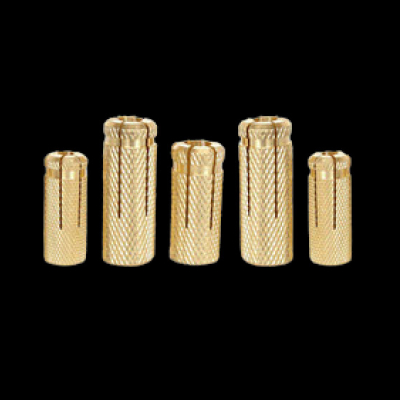
BRASS ANCHOR
Brass anchors selected around the connection—not just the catalogue name
A brass anchor is a compact, internally threaded fixing used to create a reusable female thread inside a prepared hole. Depending on its design, tightening the matching screw or bolt causes the slotted or expandable portion to press against the wall of the hole. External knurling or surface geometry helps resist rotation while the internal thread accepts the mating fastener. This makes the product useful where a neat, recessed fixing point is preferred and where the fixture may need to be removed without immediately discarding the embedded anchor.
The term brass anchor fastener is used broadly in the market. It can describe short knurled inserts, slotted expansion anchors, brass drop-in anchors and requirement-specific variants. Similar names do not guarantee identical dimensions, thread systems or performance. A buyer should therefore identify the actual body diameter, anchor length, internal thread, bolt engagement, base material and installation method rather than ordering from a photograph alone.
Shree OSR Enterprises supports requirement-led enquiries for brass anchors and related industrial fasteners across India. Share the drawing or approved sample when available. If neither exists, send the nominal thread, anchor dimensions, matching screw or bolt, fixture details, substrate, quantity and delivery city. The team can then confirm what is commercially available for the stated requirement. Browse the complete industrial product range or use the contact page for a written enquiry.
This page is intended for contractors, fit-out teams, distributors, OEM purchasers, electrical and plumbing installers, maintenance departments and procurement teams. It explains what must be checked before a quotation or site installation. It does not assign a universal safe working load to every brass anchor. Capacity depends on the exact anchor, base material, hole quality, embedment, spacing, edge distance, fastener engagement and manufacturer test data. Structural or safety-critical connections must be approved by the responsible engineer.
How a brass expansion anchor develops its grip
The useful question is not simply “Is it made from brass?” It is how the complete anchor–bolt–substrate assembly transfers force without turning, pulling out or damaging the surrounding material.
Prepared hole
The hole provides the bearing surface around the anchor. Diameter, depth, straightness and cleanliness influence fit. An oversized, tapered or dust-filled hole can prevent the anchor body from developing the intended contact. A hole that is too small can damage the anchor or substrate during insertion.
External resistance
Knurling, grooves and body geometry improve mechanical interlock and help stop rotation. These features are not decorative. Their effectiveness depends on the substrate and on the drilled hole matching the selected anchor.
Internal thread
The female thread must match the screw or bolt diameter and pitch. Adequate thread engagement is essential. A fastener that bottoms out before clamping the fixture, cross-threads, or engages only a few turns does not create a dependable connection.
Controlled expansion
As the mating fastener is tightened, the expandable portion is displaced outward. The resulting pressure helps lock the anchor in the hole. Excessive tightening can strip threads, deform the anchor or overstress brittle masonry.
Brass anchor specification: the fields that make a quote comparable
“Need brass anchor, best rate” is not a complete specification. Two suppliers can respond with different products and both appear to answer the same enquiry. A purchasing description should make the offered items technically comparable before price is considered.
| Specification field | What to state | Why it matters |
|---|---|---|
| Anchor style | Knurled, slotted, drop-in, plain or drawing reference | Defines the body and expansion mechanism; market terminology varies. |
| Internal thread | Metric, BSW, UNC or other system; nominal size and pitch/TPI | Prevents a mismatched mating bolt and thread damage. |
| Body dimensions | Outside diameter, length, slot length and relevant profile dimensions | Controls hole preparation, embedment and interchangeability. |
| Material | Required brass grade/composition when specified | “Brass” describes an alloy family, not one universal composition. |
| Finish | Natural brass or required plating/coating | Affects appearance, interface compatibility and exposure response. |
| Mating fastener | Bolt/screw material, thread, length and required engagement | The anchor and fastener operate as one assembly. |
| Base material | Concrete strength/condition, solid brick, solid block, stone, timber or tested substrate | Anchor behavior changes with density, strength, voids and brittleness. |
| Installation data | Hole diameter/depth, embedment and tightening guidance | Creates a repeatable site method and inspection point. |
| Quantity | Pieces per size, phased quantities and packaging preference | Enables meaningful bulk pricing and dispatch planning. |
| Evidence | Sample approval, drawing, inspection report, material evidence or test data | Documentation must be requested and confirmed; it is not implied. |
Dimensions should come from the approved drawing, sample or confirmed supplier data. Do not assume that an M8 internal thread means the outer body diameter or anchor length is standard across brands. Even when the mating thread is identical, geometry can differ. Replacement work deserves extra care because the existing hole may have been drilled for an older or proprietary anchor.
Buying tip: issue one line per size in the bill of materials. Include thread, body diameter × length, material/finish, quantity, substrate and delivery location. Ask every bidder to identify deviations instead of silently substituting an “equivalent.”
Why choose brass—and when another anchor may be more suitable
Useful characteristics of brass
Brass combines machinability, a clean internal thread and general corrosion resistance in many ordinary environments. It is non-rusting in the familiar red-iron-oxide sense, although brass can still tarnish, stain or suffer environment-specific corrosion. Its comparatively workable body can support precise thread production and controlled deformation in suitable expansion-anchor designs.
A recessed internally threaded anchor can also offer a tidy installation. Once installed, only the selected screw or bolt and fixture are visible. If the design permits, the fixture may be removed while the anchor remains in place. These characteristics can make a brass anchor attractive for sanitary accessories, electrical fittings, light equipment, joinery, interior fixtures and selected masonry applications.
None of these benefits replaces verification. Moisture, salts, chemicals, temperature, contact with other metals and electrical conditions can change material performance. When dissimilar metals touch in a wet environment, galvanic compatibility needs review. The mating screw should not be chosen separately from the anchor.
Cases that need comparison
- Higher structural demand: a qualified wedge, sleeve, drop-in or chemical anchoring system may be required.
- Cracked concrete or seismic design: use products with the exact assessment and approval required by the engineer.
- Hollow masonry: an expansion insert intended for solid material may not engage the shell safely; use a system tested for that base.
- Aggressive exposure: stainless steel or another specified material may be more appropriate after compatibility review.
- Unknown substrate: investigate and, where required, conduct site testing before final selection.
Compare related options in the heavy-duty anchor range, the wedge anchor product page, or the stainless-steel drop-in anchor page. The goal is not to declare one material universally best; it is to match the fixing mechanism and evidence to the connection.
Where brass anchor fasteners are considered
An application list is a starting point, not approval. The fixture weight, operating forces, substrate, geometry and consequence of failure determine whether the selected anchor is appropriate.
Interior fixtures
Brackets, rails, cabinets, display fittings and selected architectural accessories may use an internally threaded brass anchor where the base is suitable and the connection demand falls within verified data. Removable fixtures benefit from a stable female thread, but repeated removal should not be assumed unlimited; inspect the anchor and thread condition.
Electrical and mechanical fittings
Small enclosures, clips, supports and equipment accessories may require a compact fixing. Confirm clearance, electrical considerations, vibration, maintenance frequency and the mating screw. Services should never be fixed into an unverified wall merely because the accessory itself is light.
Plumbing and sanitary accessories
Brass is familiar in plumbing environments, but that does not make every brass anchor suitable for continuous moisture, chemicals or dissimilar-metal contact. Consider water exposure, sealant, substrate integrity, corrosion compatibility and access for inspection.
Concrete and solid masonry
Brass expansion anchors are commonly discussed for drilled installation in concrete, solid brick, block and stone. “Masonry” is too broad for final selection. Solid clay brick, perforated brick, lightweight block and dense concrete behave differently under expansion pressure.
Joinery and furniture work
Some brass threaded inserts or anchors are designed for timber and engineered boards. Their thread form and installation method may differ from masonry anchors. Do not use the labels interchangeably. Confirm whether the product is designed to expand, screw into the material or be pressed into a prepared hole.
Maintenance and replacement
A recessed female fixing can help when a detachable guard, cover or accessory needs periodic access. For replacement, measure the existing hole and identify the old thread. If the base has cracked, enlarged or deteriorated, simply installing a larger anchor may not be an acceptable repair.
Start with the substrate: five checks before selection
Post-installed anchors rely on the material surrounding the drilled hole. Identifying that material is often more important than choosing between two similar-looking anchors.
1. Is the base solid, hollow or layered?
Concrete, solid brick and natural stone can offer continuous material around the embedment. Hollow block and perforated brick contain webs and voids, so a short expansion zone may land partly in empty space. Plaster, tile or insulation is normally a finish, not the structural base. Measure the finish thickness separately and ensure the anchor engages the intended substrate.
2. Is the material strong enough for expansion pressure?
Mechanical expansion creates radial pressure. Weak, cracked or brittle material can crush or split. Old masonry may contain variable units and mortar joints; natural stone can contain veins or hidden defects. Avoid assuming that visual hardness equals verified capacity.
3. Where are the edges, joints and nearby anchors?
Expansion near a free edge can cause breakout or splitting. Closely spaced anchors can create overlapping stress zones. Respect the product-specific minimum edge distance and spacing. Where no verified data exists, the designer must establish an acceptable solution rather than relying on a generic online table.
4. What loads and movement will occur?
Tension tries to pull the anchor out; shear acts across it. Brackets often create both, plus leverage because the load sits away from the wall. Doors, motors, pumps and frequently handled fixtures may add vibration, impact or cyclic loading. Include the actual service condition in selection.
5. Is the base cracked or safety critical?
An unqualified brass insert should not be presumed suitable for cracked concrete, overhead life-safety supports, guardrails, lifting points, seismic restraint or other high-consequence use. Read the site’s guide to cracked versus non-cracked concrete and obtain project-engineer approval where required.
A controlled brass anchor installation sequence
Follow the instructions issued for the exact product. The sequence below is a planning checklist, not a substitute for manufacturer installation data or an engineered method statement.
Confirm before drilling
Verify the anchor code, internal thread, body dimensions, matching fastener and approved location. Scan for concealed electrical, plumbing and reinforcement hazards where applicable. Check edge distance, spacing and fixture-hole alignment.
Select the specified drill
Use the hole diameter stated for the anchor, not an estimate based on the mating bolt. A worn bit can cut differently from its marked size. Use the correct drilling mode for the substrate; aggressive percussion can damage brittle brick, tile or stone.
Control hole depth
Mark the drill or use a depth stop. Provide the specified embedment plus any allowance instructed for dust. Avoid unnecessary deep drilling, and do not allow the anchor to sit proud when a flush position is required.
Clean the hole
Remove drilling dust using the approved method. Dust can reduce contact, hide damage and prevent full insertion. Cleaning is especially important when the same operation also serves other anchor types with stricter procedures.
Inspect and insert
Reject anchors with damaged threads, distorted slots or contamination. Insert in the specified orientation and with the recommended tool. Do not strike the threaded mouth directly with a hard hammer; protect it if light tapping is permitted.
Fit the fixture
Align without forcing the screw sideways. Engage the bolt by hand for the first turns to avoid cross-threading. Confirm sufficient engagement while ensuring the screw does not bottom inside the anchor before the fixture is clamped.
Tighten as instructed
Use the specified torque or installation endpoint. “As tight as possible” is not a controlled method. Excess torque may strip the brass thread, over-expand the body, crush masonry or damage the fixture.
Inspect and record
Check seating, fixture contact, rotation, cracking and any required torque record. For repetitive installations, use a sample or trial area to confirm the method before full production. Quarantine questionable locations for review.
Brass anchor vs other common anchoring systems
No anchor family wins every comparison. Use the table to identify the questions that require project-specific verification.
| Anchor family | Typical configuration | Useful selection characteristic | Important limitation/check |
|---|---|---|---|
| Brass expansion anchor | Internally threaded, compact body; knurled/slotted variants | Recessed female thread, neat fixture removal, brass material characteristics | Confirm exact substrate, capacity, expansion and thread engagement. |
| Steel drop-in anchor | Internally threaded insert set inside a drilled hole | Flush fixing point for threaded rod or bolt in suitable concrete | Usually needs its specified setting tool and verified embedment. |
| Wedge anchor | Stud anchor with an expansion clip near the embedded end | Through-fixing and high-capacity options in qualified concrete applications | Substrate condition, edge distance, torque and qualification are critical. |
| Sleeve anchor | Stud or bolt with an expanding sleeve | Broad sleeve contact; variants for concrete and masonry | Hole size and expansion can affect weaker masonry. |
| Chemical anchor | Resin plus threaded rod/rebar or internally threaded insert | Flexible embedment and reduced expansion force in many systems | Hole cleaning, cure time, temperature and product approval control performance. |
| Nylon/frame fixing | Polymer sleeve with screw | Convenient for frames and selected light-duty masonry fixing | Temperature, fire requirements, base type and screw specification matter. |
For a deeper mechanical-anchor comparison, read Sleeve Anchor vs Wedge Anchor and Wedge Anchors vs Drop-In Anchors. These links support the buyer journey without forcing unrelated product links into the copy.
Inspection points for bulk and project procurement
A low unit price has little value if the thread does not fit, the body does not match the approved hole or mixed sizes reach the workfront. Define acceptance before ordering.
Dimensional control
Check internal thread using the agreed gauge or mating fastener, plus outside diameter, overall length, slot geometry and any drawing dimensions. Sampling frequency should reflect quantity, criticality and the buyer’s quality plan. Visual similarity is not dimensional inspection.
Thread condition
Look for burrs, incomplete threads, contamination, cross-threading and deformation at the mouth. The selected bolt should start cleanly and engage to the required depth. Do not force a mismatched pitch simply because nominal diameter appears correct.
Material and finish
Confirm the specified brass and finish. Colour alone cannot prove alloy composition. If material evidence, chemical composition, plating thickness or another record is required, state the document and acceptance criteria in the enquiry and purchase order.
Expansion features
Inspect slots, knurling and body shape for consistency. Blocked slots or distorted segments may change installation. Agree whether a sample installation, pull test or other project-specific validation is required.
Identification and packing
Separate sizes and thread systems clearly. Labels should identify the item, size, quantity and traceability information required by the order. Packaging should protect threads and finishes through transport and site storage.
Commercial alignment
Compare quotation scope, taxes, freight, packing, dispatch basis, lead time and documentation—not only piece rate. Confirm whether matching bolts or screws are included. Read the industrial fastener selection guide for a broader procurement checklist.
From brass anchor enquiry to approved supply
1. Define
List each thread and body size, quantity, base material, fixture, exposure, delivery city and required evidence. Attach drawings, schedules, photographs or an approved sample.
2. Clarify
Resolve missing pitch, dimensional tolerance, finish, matching-fastener and packaging details. Identify any proposed deviation before commercial comparison.
3. Approve
Where the job requires it, approve a sample, drawing or technical submission. Ensure the installation method and substrate are covered by the project’s design review.
4. Release
Confirm final quantity, price basis, taxes, freight, delivery sequence and documents. Inspect received goods against the approved requirement before installation.
Format your enquiry for a faster comparison
Example: Brass expansion anchor; internal thread M8 × 1.25; body diameter × length as drawing BA-08; natural finish; for approved solid-masonry fixture detail; 5,000 pieces; individually segregated by batch; delivery to [city, PIN]; required documents [list]. Please identify all deviations and confirm whether the matching screw is included.
Do not copy the example dimensions into a real order unless they match your approved design. If you only have a physical sample, provide clear measurements and arrange sample matching with the supplier.
Send your brass anchor requirementBrowse related productsBrass anchor frequently asked questions
What is a brass anchor?
A brass anchor is an internally threaded fixing inserted into a prepared hole to receive a screw or bolt. Many masonry versions use external knurling and a slotted or expandable body. Tightening the matching fastener causes controlled expansion or engagement with the surrounding material. The exact mechanism and suitable base depend on the product design.
Is a brass anchor the same as a brass drop-in anchor?
The names are sometimes used interchangeably in trade catalogues, but not every product sold under them has the same geometry or setting method. Ask for a dimensioned drawing or sample reference. Confirm whether expansion occurs by driving a setting tool, tightening the mating screw, or another method.
Can brass anchors be used in concrete?
Some brass expansion anchors are intended for solid concrete and masonry. Suitability and capacity must be confirmed for the exact anchor, concrete condition, hole, embedment, spacing, edge distance and load. Do not presume suitability for cracked concrete or structural connections without the necessary qualified data and design approval.
Can I install a brass anchor in brick?
Potentially, when the anchor is intended for that brick type and the connection is verified. Solid clay brick, perforated brick, lightweight block and mortar joints are not equivalent. Avoid weak edges and damaged units, and follow the specified drilling mode to reduce cracking.
Which drill-bit size should I use?
Use the hole diameter specified for the exact anchor body, not the internal thread or bolt diameter. Confirm the drill bit’s condition and actual hole size. If the supplier has not provided installation data, obtain it before site work.
How much bolt engagement is required?
Engagement must be sufficient for the thread and load while leaving room for the fixture and washers. The bolt must not bottom inside the anchor before clamping. Use the approved product data or engineering requirement; there is no single engagement rule that safely covers all designs.
Why does a brass anchor spin in the hole?
Common causes include an oversized or poorly cleaned hole, the wrong anchor size, weak substrate, damaged knurling, insufficient insertion or excessive tightening. Stop rather than continuing to rotate it. The hole and substrate should be assessed before a repair is selected.
Is brass corrosion proof?
No material should be described as corrosion proof in every environment. Brass offers useful corrosion resistance in many ordinary conditions but can tarnish or experience particular corrosion mechanisms depending on moisture, salts, chemicals, alloy composition and contact with other metals. Confirm compatibility for the actual exposure.
Can brass anchors be reused?
The removable screw or bolt may be reusable if undamaged and if the design permits, but the embedded expansion anchor should not automatically be removed and reused. Inspect internal threads and anchor stability whenever a fixture is refitted. Follow the responsible engineer’s requirements for critical connections.
Are brass anchors suitable for overhead fixing?
Do not use a generic, unqualified product for overhead or life-safety applications. Falling-object consequences require a properly designed and qualified anchoring system, competent installation, inspection and documentation. Approval must cover the exact substrate and service conditions.
What information affects brass anchor price?
Internal thread, body dimensions, brass grade, finish, tolerance, quantity, packaging, inspection documents, testing, freight and delivery schedule all influence a quotation. Request price against a complete specification so competing offers cover the same item.
Does Shree OSR Enterprises supply custom sizes?
Custom or requirement-specific availability must be confirmed against the drawing, material, quantity and production feasibility. Send the technical requirement through the contact page; do not assume that every thread, dimension or finish is held in stock.
What should I send for a bulk enquiry?
Send the anchor type, internal thread and pitch, body diameter and length, material/finish, matching fastener, substrate, fixture, quantity per size, delivery location, required date and requested documentation. A drawing or approved sample reduces ambiguity.
How do brass anchors compare with wedge anchors?
A typical brass anchor provides a recessed internal thread, whereas a wedge anchor is generally a projecting stud with an expansion clip and nut. They suit different connections and load regimes. Compare base material, qualification, load, edge/spacing limits, corrosion exposure and installation access—not just size or price.
Common installation symptoms and what they may indicate
A symptom is evidence to investigate, not permission to improvise. Record the product batch, location, hole preparation, tool, installer and substrate condition before the failed detail is disturbed.
The anchor rotates during tightening
Possible contributors: an oversized hole, worn drill bit, smooth or weak substrate, missing dust removal, damaged external knurling, incorrect anchor body or excessive torque. Continued rotation can enlarge the hole and destroy remaining contact. Remove the fixture without worsening the base, assess the hole and use only an approved repair. Adhesive, packing pieces or a larger insert should not be added casually.
The bolt starts but quickly jams
Possible contributors: a pitch mismatch, burr at the thread mouth, cross-threading, debris, distorted anchor or damaged bolt. Compare the markings and measure the thread. Never use force to “cut” a steel bolt through a softer brass thread; the connection may appear tight while having little sound engagement.
The anchor will not enter fully
Possible contributors: insufficient hole depth, dust at the bottom, a tapered hole, incorrect body diameter, deformation or contact with reinforcement/another obstruction. Do not hammer harder without diagnosis. Recheck depth and diameter with the approved method, and follow the site procedure if reinforcement has been encountered.
The fixture remains loose after tightening
Possible contributors: the bolt bottoms inside the anchor, fixture thickness differs from the design, insufficient thread engagement, anchor movement, uneven bearing surface or missing washer/spacer. A longer or shorter bolt is not automatically the answer; confirm available thread depth and required engagement.
Cracking or spalling appears around the hole
Possible contributors: the anchor is too close to an edge, the hole is too small, expansion force is excessive, the substrate is weak, percussion drilling damaged the material, or tightening exceeded the approved endpoint. Stop work in the affected zone and seek technical review. Cosmetic filling does not restore capacity.
Fixings vary across the same wall
Possible contributors: mixed brick types, mortar joints, voids, repaired areas, inconsistent drilling or anchors from mixed sizes/batches. Map the pattern. Where base material varies, the design may require investigation, proof testing or a different anchor system rather than stricter installer effort alone.
Exposure, brass grade and mating-metal compatibility
Brass is a copper–zinc alloy family. Alloy composition, processing and environment influence strength, machinability and corrosion response. A catalogue description that says only “brass” may be adequate for a routine commercial enquiry when no grade is specified, but it is not enough when the project drawing or client standard requires a particular composition. State the grade or applicable material requirement and request the matching evidence.
Natural brass develops colour changes with time. Tarnish may be an appearance issue rather than immediate functional failure, but unusual staining, cracking, powdery deposits or loss of section should be investigated. Cleaning chemicals, ammonia-bearing environments, chlorides, industrial pollutants, trapped moisture and sustained stress can create conditions that ordinary indoor experience does not predict.
When different metals are electrically connected in the presence of an electrolyte such as water, galvanic action can accelerate attack on one metal. The risk depends on metal pairing, relative exposed areas, conductivity and wetness duration. A small brass component connected to a large area of another metal can behave differently from an indoor dry joint. Seek materials advice for coastal, chemical, continuously wet or otherwise aggressive service.
Plating may be specified for appearance, interface behavior or another functional purpose, but a coating name alone is incomplete. State the coating system, thickness or performance requirement where relevant. Confirm whether the internal thread must be gauged after coating and whether the mating fastener needs a compatible finish. Coating build can affect fit in close threads.
Temperature also matters. Thermal expansion, softening of connected materials and repeated heating/cooling can change clamp force. Fire-rated supports require a system assessed for the applicable fire condition; the presence of a metal anchor does not itself establish fire performance. Similarly, a brass component should not be presumed non-sparking or suitable for an explosive atmosphere without explicit material and system assessment.
For outdoor fixtures, prevent water traps where possible and consider whether the drilled hole permits water ingress into masonry. Sealing should follow the approved detail and must not interfere with anchor expansion. In wet areas, inspect accessible connections as part of maintenance rather than treating installation as the final quality event.
For an OEM product, consider the full service life: assembly torque, vibration, cleaning products, transport, storage, customer maintenance and eventual disassembly. If the same female thread will be used repeatedly, define an inspection or replacement rule and confirm that the product design supports the expected cycles.
Build a usable submittal, method statement and inspection trail
Technical submittal
Identify the proposed product, manufacturer or supply reference, dimensions, internal thread, material, finish, intended substrate and matching fastener. Attach the drawing and relevant data for the exact offered variant. Highlight deviations from the tender, drawing or bill of quantities. Generic brochures covering many products should not hide which item is proposed.
Sample approval
Label the sample with the enquiry and item code. Check it against the proposed drawing and mating fastener. If the approval depends on appearance, include an agreed finish reference. A sample confirms the submitted piece; it does not by itself prove bulk consistency, material composition or anchor capacity.
Method statement
Describe setting-out, hazard scanning, drilling tool and mode, bit diameter, depth control, hole cleaning, insertion, bolt engagement, tightening, repair of failed holes and protection of finished work. Assign responsibilities and reference the approved product instructions. Include access and work-at-height controls where relevant.
Inspection plan
Define hold points and sampling: substrate confirmation, drill-bit check, hole dimensions, anchor identity, installation observation, torque or setting verification, visual inspection and any required tests. State acceptance criteria and the authority permitted to release nonconforming locations.
Receiving inspection
Compare delivery labels and quantities with the purchase order. Keep different internal threads and body lengths segregated. Check for moisture damage, contamination, dented thread mouths and mixed products. Retain required documents with the lot they represent rather than filing them as unrelated paperwork.
As-built records
For controlled work, record locations, product/batch identity, date, installer, inspection status and approved deviations or repairs. Photographs can support—but do not replace—measurements and signed inspection. The record should allow a future maintainer to understand what is embedded behind the fixture.
Documentation availability is requirement-led and must be confirmed before purchase. If a project needs a material certificate, dimensional report, test evidence, sample, third-party inspection or another record, name it explicitly in the enquiry. For general selection principles, see How to Choose the Right Industrial Fasteners.
Storage, handling and the final pre-order check
Protect the product before it reaches the hole
Store brass anchors dry, covered and separated from incompatible chemicals or contamination. Keep original labels with each lot. Mixed metric and imperial threads can be difficult to distinguish visually, so use clearly marked bins and never return unidentified loose pieces to approved stock.
Protect the internal thread and expandable body from impact. Avoid throwing small anchors into dirty toolboxes where abrasive dust or metal swarf can enter the thread. If anchors are supplied with matching screws or tools, keep the set together by item code.
At the workface, issue only the size required for the activity. This reduces substitution and makes quantity reconciliation easier. Return unopened, identified stock to storage; quarantine damaged, wet, mixed or untraceable material. First-in/first-out control can help prevent forgotten lots, but traceability and condition take priority.
When handling plated or appearance-sensitive parts, use clean methods that avoid scratching. Do not apply oil, grease, thread-locking compound or sealant unless the approved installation instructions allow it; lubrication can alter tightening behavior and chemicals can affect compatibility.
Before sending the purchase order, confirm:
A complete purchase order reduces three expensive risks: a commercially cheap but technically different offer, site delays caused by missing matching fasteners, and acceptance disputes after delivery. Where the designer’s information is incomplete, raise a technical query before ordering rather than filling the gap with a supplier assumption.
Four buying scenarios—and the question that changes each one
Contractor pricing a new fit-out
The schedule may say only “brass anchor with screw.” Before pricing, identify the partition or structural wall behind the finish, fixture thickness, hole access, quantity by fixture and client approval requirement. A sample room can confirm alignment and installation sequence, but the substrate may vary between floors. Include wastage only as a commercial allowance; it must not become permission to accept failed anchors. Ask the designer to clarify load and fixing detail where the schedule is silent.
Distributor replenishing stock
Historic names such as “small,” “medium” or “No. 10 brass anchor” may be understood locally but are risky across manufacturers. Build stock codes around measurable thread and body dimensions. Keep metric, BSW and UNC products physically separate, and publish a dimensional table tied to each code. When changing the supply source, approve interchangeability before combining old and new inventory. The question is not merely which sizes sell fastest; it is whether customers can reorder the same geometry reliably.
Maintenance team replacing an old fixing
The original drawing may be unavailable and the exposed screw may be the only obvious clue. Remove one noncritical assembly under an approved procedure, preserve the anchor/hole evidence and measure thread, body and fixture build-up. Investigate why replacement is needed: corrosion, stripped thread, vibration, substrate damage or routine access. Matching the old component is not necessarily correct if the original selection failed. Obtain engineering review when the fixture has safety consequences.
OEM buyer integrating an anchor into a product
Define assembly process as well as part dimensions. Consider automated or manual insertion, tool access, torque control, mating screw tolerance, cosmetic surfaces, inspection gauge, packaging orientation and service disassembly. Production trials should use representative substrate or housing material. If the component is custom, establish drawing revision control and a change-notification requirement so a visually minor geometry change cannot enter production without review.
These scenarios demonstrate why a national product page should answer shared technical and procurement questions rather than repeat a separate block for every city. Delivery location belongs in the quotation because it affects freight and timing; it does not change the definition of the brass anchor. This distinction helps the page serve buyers across India while avoiding thin, near-duplicate location content.
Send the specification. Receive a brass anchor quote built around it.
Shree OSR Enterprises supports brass anchor, mechanical anchor and industrial fastener enquiries for buyers across India. Provide the thread, dimensions, brass/finish requirement, substrate, fixture, quantity, documents and destination. The team can review the stated scope and confirm availability, pricing and delivery terms without hiding important assumptions behind a generic product name.
For broader technical context, explore what industrial fasteners are or review the site’s anchors and fasteners articles.