
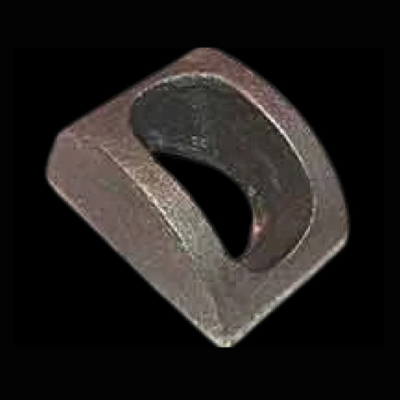
Hillside Washer
| Material | Mild Steel |
|---|---|
| Usage/Application | Mechanical |
| Surface Finish | Metal Coated |
| Color | Black |
| Type | Hillside Washer |
| Dimension/Size | M16-M32 |
Hillside washers for angled rod-bracing connections
A hillside washer creates a practical bearing interface where a diagonal threaded rod or bracing member passes through structural steel at an angle. Its shaped upper surface allows the nut to sit in a more suitable orientation than it would on an ordinary flat washer, while the base transfers force into the supporting steel surface.
Shree OSR Enterprises supplies hillside washers for mechanical, construction and structural hardware requirements. The current product listing identifies mild steel, a black metal-coated finish and an enquiry range of M16 to M32. That range commonly translates into requests for M16, M20, M24 and M32 hillside washers, but size alone is not a complete specification. The rod diameter, slot geometry, washer profile, connection angle, bearing area, material requirement, finish and drawing revision must work together.
This component is often searched as a hill side washer, cross-bracing washer, half-moon washer, PEB washer or curved washer for a tie rod. Those names can describe related shapes rather than one universal interchangeable product. A sample photograph may identify the family, but it cannot establish the correct dimensions or capacity. For repeat orders, refurbishment, imported equipment or drawing-controlled steelwork, send the existing part, a dimensioned sketch or the approved connection detail.
The purpose of this page is to help engineers, PEB fabricators, structural contractors, maintenance teams, distributors and procurement managers prepare a technically clear enquiry. It does not publish a generic safe load, angle range or tightening torque because those values depend on the exact washer geometry and the complete engineered connection. For structural or safety-critical work, the responsible engineer should approve the washer, rod, nut, slot, supporting member and installation procedure as one assembly.
How a hillside washer supports an angled connection
The useful feature is not simply a thicker washer. It is the relationship among a flat bearing base, a curved or contoured upper face, the rod opening and the nut-bearing position. Together, these features help an angled brace terminate against a structural member without forcing an ordinary flat washer and nut to bear awkwardly.
The brace approaches at an angle
A diagonal rod used in roof or wall cross-bracing rarely meets a column web, beam, purlin or plate at ninety degrees. The connection opening therefore has to accommodate the rod's actual route without bending, kinking or damaging the thread.
The base seats on steel
The underside of the hillside washer bears against the prepared structural surface. The available footprint, slot position, surrounding steel thickness and edge condition influence how that force enters the member. Paint lumps, burrs and an undersized seating area can prevent proper contact.
The profile receives the nut
The shaped upper surface lets the nut and any specified companion washer align more appropriately with the inclined rod. This reduces the severe edge contact that can occur when a conventional nut is tightened against a flat washer while the rod axis is oblique.
Tension enters the bracing system
As the approved nut is tightened or the brace is tensioned, force travels from the rod through the nut and hillside washer into the supporting member. The washer does not create the bracing capacity by itself; it is one part of a load path controlled by the rod, connection geometry and structure.
M16–M32 hillside washer enquiry range
Current listing: MS • black • metal coated| Enquiry size | How to state it | Information still needed | Do not assume |
|---|---|---|---|
| M16 | M16 hillside washer for an angled bracing rod | Exact opening, profile, overall dimensions, angle, material, finish and quantity | That every M16 casting fits every M16 connection |
| M20 | M20 hill side or cross-bracing washer | Rod pitch, nut dimensions, supporting-member thickness, slot and drawing | A safe load or torque based only on nominal size |
| M24 | M24 MS hillside washer for PEB bracing | Bearing footprint, brace geometry, finish exposure, inspection documents and delivery | Compatibility with a competitor's M24 pattern |
| M32 | M32 structural bracing washer, drawing controlled | Complete engineered detail, material requirement, batch quantity, testing and approval | That larger diameter automatically solves a load or misalignment problem |
What “M20” actually tells you
The M designation normally points to the nominal metric thread diameter of the matching rod or bolt. It does not define the washer's outside length and width, opening shape, casting thickness, spherical radius, working angle, locking feature, material grade or coating. Record those separately. If the part will be paired with a new rod, review the site's GI threaded rod and stainless-steel threaded rod options only after the approved assembly material is known.
Why no generic dimension chart is shown
Hillside washer patterns vary between manufacturers and connection systems. Publishing borrowed dimensions would create false interchangeability and could send a fabricator toward the wrong slot. Shree OSR Enterprises should confirm supplied dimensions against its current product drawing, approved sample or quotation. For a replacement, measure the part and identify the connection rather than ordering from a marketplace photograph.
Where hillside washers are commonly specified
Applications are best described by the load path and connection detail, not by an industry label alone. The examples below are starting points for engineering review; they are not automatic approvals for every structure.
PEB wall cross-bracing
Diagonal rods can support the stability system between columns in pre-engineered metal buildings. Where the rod passes through a web or prepared plate at an angle, a correctly profiled hillside washer can provide a more suitable nut-bearing surface. Verify the erection drawing, brace force, rod size, slot, washer footprint and supporting steel.
Roof and rafter bracing
Roof-plane rods, sag rods and related tension members may meet rafters, purlins or connection plates obliquely. Access, roof slope and the available surface can limit seating. Confirm that the washer does not clash with lips, stiffeners, sheeting, bolts or adjacent members and that installers can tension the assembly safely.
Industrial sheds and warehouses
Long bays and lightweight framing frequently use diagonal bracing to transfer wind and erection actions. A hillside washer may form part of the rod termination, but bracing layout, temporary stability and final tension remain controlled by the structural documents. Never remove, loosen or relocate a brace because it obstructs another trade.
Steel columns and beams
Threaded rods or cable-end assemblies can pass through column webs, beam webs or fabricated cleats. The washer base needs enough sound, flat bearing steel around the opening. Thin webs, large slots, corroded members, nearby edges or local distortion may require reinforcement or a different connection designed by the engineer.
Retrofit and maintenance work
An existing hillside washer may need replacement after corrosion, thread damage, unauthorised modification or loss. Matching only the nominal rod size is risky when the original pattern is unknown. Isolate or support the structure as required, capture the existing geometry and obtain approval before disturbing a tensioned bracing system.
Fabricated special assemblies
Custom steelwork, towers, equipment frames and non-standard bracing can use a curved-bearing washer concept where a rod crosses a flat member at an angle. The product may require a controlled drawing, different material or special surface protection. A standard M16–M32 item should not be forced into a geometry it was not made to accommodate.
Choose a hillside washer from the connection outward
A clear selection sequence prevents the common mistake of treating the washer as an isolated catalogue part. Complete each gate before moving to price comparison or purchase approval.
Start with the approved bracing detail
Identify the structure, grid line, connection mark, design drawing and current revision. Confirm whether the member is permanent cross-bracing, temporary erection bracing, a sag rod or another tension system. Record the design force, load combinations and consequence of failure through the responsible engineer. A product photo or old invoice does not replace the connection detail.
Define the rod and thread
State nominal diameter, thread system, pitch, rod material or property requirement, surface finish, nut type and required engagement. Confirm whether the rod is straight, upset, forged, welded to an eye or part of a turnbuckle assembly. The matching nut must run freely on the finished thread and meet the specified mechanical class. Do not mix metric and inch parts that appear close.
Capture the real connection angle
Use the issued geometry, not a visual estimate from the floor. The angle affects the path through the member, the required slot and where the nut bears on the washer. Check the full tolerance range from fabrication and erection, not only the ideal model. If the brace angle falls outside the approved washer profile, change the connection design rather than grinding the product.
Coordinate the opening and locking feature
The rod must pass through the washer and structural member without binding. An angled rod often needs an elongated opening in the supporting steel. Its length, width, orientation and clearances must follow the approved detail. If the washer pattern includes a tab or locating feature, the slot must accommodate it correctly; removing the tab can change how the washer resists sliding or rotation.
Check bearing area and local steel
Confirm the washer footprint fits fully on sound steel. Review the member thickness, slot size, distance to edges, welds and neighbouring holes, as well as local web yielding, crippling, bending or buckling where relevant. A large washer is useful only when the supporting member can receive its load. A washer overhanging a flange edge or rocking on a weld bead does not create reliable bearing.
Select material and surface protection
Match the approved mechanical material to the environment and service life. The current page lists mild steel with a black metal-coated finish; alternative materials or finishes must be confirmed rather than assumed. Describe indoor humidity, outdoor rain, coastal salt, industrial chemicals, temperature, fire protection, contact with dissimilar metals and future inspection access.
Lock inspection, records and commercial terms
Define required dimensions, tolerances, marking, sample approval, material certificate, batch testing, coating records, third-party inspection and traceability before placing the order. Then state quantity, pack size, delivery schedule, destination and whether partial dispatch is acceptable. Early document planning avoids receiving a physically usable part that cannot be accepted under the project's quality plan.
One-minute approval test
Can the buyer identify the approved drawing, rod, thread, washer profile, connection angle, support surface, material, finish and quality evidence? If any answer is missing, treat the enquiry as incomplete. Browse the complete industrial product range for related hardware, but do not substitute a plain washer, DTI washer, spring washer or fabricated block without engineering approval.
Material, finish and exposure are separate decisions
“Black,” “mild steel” and “metal coated” answer different parts of a specification. Colour does not confirm coating chemistry; material name does not confirm mechanical grade; and a coating does not make an unsuitable base material structurally acceptable.
Mild-steel product
The live listing identifies mild steel as the product material. Mild steel is widely used for fabricated and cast construction hardware because it can offer practical availability and economy. However, “MS” alone is not a complete controlled material specification.
- State the required material grade or approved drawing note.
- Confirm the manufacturing route where it affects acceptance.
- Define mechanical testing or certificate requirements.
- Do not copy another supplier's stated ASTM, DIN or IS grade.
Black metal-coated finish
The current product table identifies a metal-coated black surface. Before relying on it for corrosion protection, ask what the finish actually is, how it is applied and whether a thickness or performance requirement is controlled.
- Black appearance can come from several different systems.
- Storage oil or a dark conversion finish is not automatically an outdoor coating.
- Coating may alter dimensions and nut-bearing friction.
- Touch-up after damage needs an approved method.
Alternative protection
For wet, exposed or corrosive service, the project may call for galvanizing, a paint system, another conversion coating or a different base material. Availability has to be confirmed against the exact washer pattern and batch.
- Describe indoor, outdoor, coastal or chemical exposure.
- Coordinate the washer with rod, nut and supporting steel.
- Check trapped water and crevice locations.
- Specify packaging that protects the finished surfaces.
What determines performance in the complete bracing connection?
A hillside washer changes how an angled rod bears at its termination. It cannot be assigned an honest universal capacity without examining the failure modes around it.
Tension, thread and net section
The brace rod has to resist the calculated tension, including required safety or resistance factors. Threaded area, material strength, turnbuckle or eye details, corrosion allowance and fatigue or cyclic demand can control. Damaged, undercut, cross-threaded or partly engaged threads may fail before the washer reaches its own limit.
Bearing on the curved face
The nut needs adequate thread engagement and stable contact on the intended region of the washer profile. Severe edge contact, a nut bridging across an opening or the use of a nut geometry not covered by the detail can introduce local crushing, bending and unpredictable tightening. The rotating bearing surface should be defined in the assembly procedure.
Bending, fracture and movement
The hillside washer must transfer the rod force from its upper bearing region into its base without cracking, excessive deformation, slip or loss of seating. Geometry, material, casting or fabrication quality, discontinuities and the location of any locking feature matter. A thicker-looking replacement is not automatically equivalent if its shape or material differs.
Web, flange or plate resistance
The supporting member can govern through local bearing, yielding, bending, tearing, block failure, buckling or interaction with nearby holes and welds. The effective contact area may be less than the apparent washer footprint when the part sits near an edge or over a large slot. Reinforcement, a backup plate or a different detail may be required.
Brace stiffness and load reversal
Cross-bracing behaviour depends on whether one diagonal acts only in tension, whether both participate, how slack is removed and how wind or seismic load reverses. Initial tension, frame drift, temperature, erection tolerances and connection slip affect force distribution. Tightening one rod by feel can unintentionally unload another or distort light framing.
Corrosion, loosening and inspection
Loss of section, coating breakdown, vibration, relaxation, impact and unauthorised site changes can affect the connection after handover. Design access for visual inspection and maintenance. Define what counts as rejection, who can adjust brace tension and whether protective coating must be restored after tightening.
A controlled installation sequence for hillside washers
This sequence explains quality and safety checkpoints. It does not replace the erection drawing, engineer's procedure, product data or site method statement.
Release the correct documents
Confirm the latest structural and erection drawings, connection marks, brace schedule, material list and approved washer. Identify temporary stability requirements and the sequence in which rods may be installed or adjusted. Brief the crew on access, working-at-height controls, dropped-object prevention and exclusion zones.
Inspect the components
Verify washer size, profile, opening, material identification, finish, quantity and lot records. Check rods and nuts for correct thread and coating. Quarantine cracked, heavily pitted, distorted, repaired or ground washers; damaged threads; and components with coating loss beyond the approved touch-up limit.
Prepare the bearing surface
Confirm the hole or slot has the approved dimensions and orientation. Remove sharp burrs, weld spatter and loose contamination without enlarging or reshaping the connection. Do not flame-cut, gouge or grind the structural member or hillside washer unless the change is shown on a released repair detail.
Pass the rod without force
Bring the brace into its intended line and insert it through the structural opening and washer as detailed. The rod should not be kinked, levered or hammered sideways to create fit. Check clearance through the full angle, not just at the exposed face. Protect threads during handling and avoid dragging finished parts across steel.
Orient the washer correctly
Place the flat base on the supporting steel and the profiled face toward the nut arrangement. Locate any tab or anti-movement feature in the intended position. Confirm full, stable base contact and adequate support around the opening. The part should not rock, sit on a radius, bridge a weld or hang beyond an edge.
Install the approved nut stack
Use the specified nut and companion hardware in the correct order. Run the nut by hand far enough to prove thread compatibility. Do not use a washer stack, packing pieces, a second nut or a locking compound as an improvised response to wrong geometry. Maintain the required thread engagement after final adjustment.
Follow the bracing procedure
Tighten or tension in the approved sequence so the frame remains plumb and the bracing system shares load as designed. Use calibrated tools where a controlled torque or tension method is specified. Generic torque charts are not valid without the actual thread, grade, finish, lubrication and connection assumptions.
Check contact and alignment
Look for full base seating, intended nut contact, correct washer orientation, thread engagement, clashes, rod binding, visible cracking, coating damage and supporting-steel distortion. Record connection mark, lot and inspection result where the quality plan requires it. Do not conceal a rejected connection behind cladding.
Protect and retain records
Apply approved coating repair, corrosion protection or thread protection after acceptance. Retain certificates, inspection sheets and non-conformance closures with the structure records. Tell maintenance teams that brace adjustment is controlled work; a nut that appears loose may reflect a system issue and should not simply be tightened.
Stop work and escalate when…
- The product does not match the approved drawing or sample.
- The rod binds, bends or cannot follow the slot freely.
- The washer rocks or lacks full supporting area.
- The nut contacts only an edge of the contoured face.
- The washer, rod, nut or steel is cracked or deformed.
- The structural opening needs unapproved enlargement.
- Required torque, tension or sequence data is missing.
- Removing an existing brace could reduce stability.
Structural stability must be maintained throughout erection and alteration. As an external safety reference, OSHA's steel-erection guidance states that structural stability must be maintained during the erection process; related diagonal-bracing requirements are controlled by the engineer and erection documents. Local Indian law, the project safety plan and the responsible engineer govern work on this product's intended projects.
Quality checks buyers should define
Quality is not created by adding “best” or “heavy duty” to a purchase order. It comes from measurable requirements, controlled samples and records linked to the delivered batch.
Identity and drawing revision
Confirm product name, nominal rod size, part number where used, drawing number, revision and any approved sample. Keep M16, M20, M24 and M32 variants physically separated and labelled so mixed cartons do not reach the workface.
Critical dimensions
Define the opening width and length, overall footprint, base geometry, profile or radius, height, thicknesses, tab location and permitted tolerances. Choose an inspection sampling plan appropriate to the batch and consequence of non-conformance.
Material evidence
State whether a supplier declaration, material test certificate, heat or lot traceability, chemical analysis or mechanical test result is required. Request it in the enquiry; documents cannot always be recreated after loose pieces have been mixed.
Surface condition and finish
Inspect for cracks, laps, harmful porosity, sharp flash, burrs, heavy scale, distortion and coating defects. Define the coating or finish, colour if controlled, inspection method, acceptable touch-up and packing separation needed to prevent transit damage.
Trial assembly
Where fit is drawing-sensitive, test the washer with a representative rod, nut and slotted plate or approved gauge. Trial assembly checks geometry; it does not establish structural load capacity unless a qualified test programme and acceptance criteria are defined.
Final release and packing
Link inspected quantity, rejected pieces, batch number and documents to the packing list. Protect profiles and coated faces, identify box weight and lifting needs, and agree whether replacement stock or staged deliveries are required for the site schedule.
Avoid the mistakes that turn a small part into a large site issue
Most hillside-washer problems begin with incomplete geometry, uncontrolled substitution or poor fit-up—not with the final turn of the spanner.
If a nut keeps loosening
Do not immediately add a second nut, spring washer or adhesive. Check rod force, thread condition, nut engagement, bearing contact, vibration, brace reversal, structural movement and coating friction. The responsible engineer should identify the cause and approve the retention method.If the washer has shifted
Restrict access if connection safety is uncertain. Record its original and current position, inspect any tab and slot, check base contact and supporting-steel damage, and review whether the bracing system has been overloaded or incorrectly tensioned. Do not hammer it back under load.Hillside washer vs flat, bevel, spherical and clevis solutions
These products may all appear near an angled or structural connection, but they solve different geometric and mechanical problems. Substitution must follow design review.
Hillside washer
THIS PRODUCT- Core function
- Provides a profiled bearing interface for a diagonal rod passing through a structural member, often in metal-building cross-bracing.
- Useful when
- The approved detail needs a flat base on steel, an angled rod path and a nut-bearing profile able to accommodate the intended geometry.
- Key check
- Match rod, slot, angle, footprint, profile and support surface. Do not assume a universal capacity or angle range.
Flat washer
- Core function
- Spreads nut or bolt-head bearing on a surface that is normally perpendicular to the fastener axis.
- Useful when
- The joint geometry already provides suitable parallel bearing surfaces and the applicable assembly standard calls for it.
- Key check
- A flat washer does not correct a substantial angular mismatch; edge bearing can distort the nut, washer or joined part.
Bevel or taper washer
- Core function
- Provides a fixed slope, commonly to compensate for a known flange or channel taper in a bolted connection.
- Useful when
- The required angle is established and matches the specific taper washer orientation and standard.
- Key check
- It normally offers one controlled wedge angle, not the contoured multi-position bearing concept associated with many hillside patterns.
Spherical washer set
- Core function
- A matched convex and concave pair accommodates angular misalignment while maintaining more complete bearing between its two pieces.
- Useful when
- Machinery, fixtures or clamping systems specify a precision alignment solution with a defined angular capability.
- Key check
- It is a paired system and should not be replaced by one curved casting or mixed with unmatched halves.
Clevis and pin
- Core function
- Forms a pinned rod-end connection to a gusset or lug, permitting controlled rotation about the pin axis.
- Useful when
- The geometry or structural model requires a pin connection rather than a threaded rod passing through the member.
- Key check
- Clevis size, pin shear and bearing, edge distances, gusset, welds and rod-end details all need design.
Fabricated plate or block
- Core function
- Creates a project-specific bearing or connection component where a standard product cannot suit the available geometry.
- Useful when
- Large forces, unusual angles, limited bearing steel or special fabrication justify a controlled engineered part.
- Key check
- Material, weldability, machining, testing, tolerances and the full load path must be defined on a released drawing.
What determines hillside washer price?
A useful quotation attaches price to a defined part and delivery requirement. A rate found online for an unspecified “M20 washer” may represent a different weight, material, pattern, finish, quantity or tax and freight basis.
M16, M20, M24 and M32 products use different material quantities and patterns. A custom profile, slot or controlled drawing can change tooling and inspection cost.
Material requirement, casting or fabrication route, machining, heat treatment where applicable, rejection allowance and raw-material market conditions affect the offer.
Plain or black condition, specified coating, galvanizing, paint, special corrosion protection, masking, touch-up and coating inspection each add different process steps.
Prototype pieces, one replacement, a standard carton and a project batch carry different setup, packing and unit economics. State total quantity and call-off schedule.
Material certificates, dimensional reports, batch tests, traceability, third-party inspection and sample approval should be included before commercial comparison.
Piece counting, labelled lots, moisture protection, export packing, pallet weight limits and separation of finished surfaces can change handling cost.
Destination PIN code, transport mode, part shipment, urgent production and offloading conditions influence landed price and achievable schedule.
Confirm whether GST and freight are included, quotation validity, payment terms, inspection hold points and the policy for approved equivalents.
Ask for a comparable, project-ready quotation
Send one line per size with drawing, material, finish, quantity, documentation, delivery city and required date. Shree OSR Enterprises can then confirm product feasibility, availability, price basis and lead time instead of guessing from a product name.
Work with Shree OSR Enterprises on the complete enquiry
Shree OSR Enterprises is headquartered in Delhi and supplies fasteners, anchors, clamps and construction hardware across India. For hillside washers, the most useful support begins with a complete specification: the team can review the requested size, drawing, material, finish, quantity, quality documents and delivery requirement before confirming the commercial offer. Read more about Shree OSR Enterprises.
Frequently asked questions about hillside washers
Use these answers to prepare an enquiry. Final selection and installation must follow the exact supplied product data and approved structural detail.
What is a hillside washer?
A hillside washer is a shaped load-transfer component used where a diagonal rod or bracing member passes through structural steel at an angle. A typical form has a flat underside that sits on the supporting member and a curved or contoured upper surface that provides a more suitable bearing region for the nut. It is commonly associated with metal-building cross-bracing, wall and roof bracing, threaded tie rods and similar structural hardware. Product patterns vary, so the name does not define one universal geometry.
Why is it called a hill side or half-moon washer?
The names describe its sloped, curved or half-round appearance. “Hillside washer,” “hill side washer,” “half-moon washer” and “cross-bracing washer” are often used as search or trade terms. However, suppliers may use those terms for products with different openings, radii, locking features and bearing footprints. Always specify the exact drawing or dimensions instead of relying on the nickname.
What sizes does Shree OSR Enterprises list?
The current product page lists a size range of M16 to M32. Common enquiries within that range include M16, M20, M24 and M32 hillside washers. Availability of an exact pattern, profile, finish and quantity should be confirmed at quotation stage. The M-size normally relates to the matching nominal metric rod or bolt thread; it does not define all washer dimensions.
Is the listed hillside washer mild steel?
Yes. The current WooCommerce specification identifies mild steel as the material, black as the colour and metal coated as the surface finish. Buyers who require a controlled steel grade, alternative material, galvanizing or another protective system should include that requirement in the enquiry. Shree OSR Enterprises should confirm feasibility and compliance in writing rather than the buyer assuming an option from another product.
Can I select a washer using only the rod diameter?
No. Rod diameter is essential but incomplete. You also need the thread and nut, rod approach angle, washer opening, structural slot, base footprint, supporting steel, material, finish, quality records and connection drawing. Two washers described as M20 may have different shapes and may not interchange. For a replacement, provide a dimensioned sample record and photographs of the complete connection.
Does a hillside washer distribute load evenly?
Its profiled bearing arrangement is intended to transfer force from an angled rod and nut into the supporting steel more appropriately than an ordinary flat washer used at a severe angle. “Evenly” should not be interpreted as perfectly uniform pressure or guaranteed capacity. Actual contact depends on geometry, stiffness, tolerances, surface condition, nut shape and loading. Engineering checks must cover the washer and supporting member.
What angle can a hillside washer accommodate?
There is no safe universal angle range for every hillside washer. The usable geometry comes from the exact profile, opening, nut, rod size, slot and supporting member. An angle published for another supplier's imperial or metric pattern should not be copied. Send the brace angle and connection drawing with your enquiry, and obtain approval for the offered product before fabricating slots or placing the order.
Does the structural member need a slotted hole?
An angled rod passing through a plate or web often needs an elongated opening so it can follow its design line without binding. Slot size and orientation depend on rod diameter, angle, member thickness, erection tolerance and any tab on the washer. The slot also removes steel from the supporting member, so its effect on bearing and local resistance must be designed. Do not lengthen a site hole without approval.
Can a hillside washer replace a clevis and pin?
Only when the structural design intentionally uses a through-rod and hillside-washer termination. A clevis and pin create a different connection with a defined pin axis and gusset or lug. They are not automatically interchangeable. For extreme angles, rotation requirements, unusual loads or limited bearing area, a clevis-and-gusset detail may be more appropriate. The responsible engineer must make that decision.
Can I use a flat washer instead?
Not as an unapproved substitution. A flat washer is intended to spread bearing where the nut face and joined surface are suitably aligned. At an oblique rod angle, an ordinary washer and nut may contact only at an edge, bend or damage the thread. If the connection drawing calls for a hillside washer, supply that approved profile or obtain a formal revised detail.
What is the safe load of an M20 or M24 hillside washer?
A defensible safe load cannot be assigned from “M20” or “M24” alone. Capacity may be governed by rod tension, thread strength, nut engagement, washer bending or fracture, bearing on the structural web, slot geometry, local steel failure, bracing behaviour or corrosion. Use calculations and product-specific evidence for the exact assembly. Do not transfer a catalogue value from a different pattern or material.
How should hillside washers be installed?
Verify documents and components, prepare the approved structural slot and bearing surface, pass the rod without forcing it, orient the washer with its base seated fully, install the specified nut arrangement and tension the bracing in the released sequence. Inspect seating, nut contact, thread engagement, alignment, distortion and finish. Installation must follow project-specific engineering and safety controls, especially when work affects structural stability.
Can a damaged or used hillside washer be reused?
Do not reuse a cracked, permanently deformed, heavily corroded, ground, welded or otherwise modified washer without qualified assessment and written approval. A part removed from a tensioned connection may also have an unknown load history. Quarantine it and inspect the surrounding rod, nut and supporting steel. Replacement is usually more controllable than an improvised repair, but the engineer should address the cause of damage.
How do I get the correct hillside washer price?
Send the nominal rod size, drawing or full dimensions, material, finish, quantity, certificate and inspection requirements, packing, delivery PIN code and required date. Price changes with size, weight, pattern, manufacturing route, coating, batch quantity, documentation, freight and raw-material conditions. Ask whether GST and freight are included and how long the quotation remains valid. Use the Shree OSR enquiry page for a current offer.
Where can I buy hillside washers in India?
Shree OSR Enterprises accepts project and bulk enquiries from its Delhi head office and serves requirements across India. The page lists M16–M32 mild-steel, black metal-coated hillside washers. Share the exact technical and commercial requirement to confirm the offered pattern, availability, price and delivery. Avoid sending only “need hillside washer”; a complete enquiry receives a faster and more comparable response.
Which documents should I request with a bulk order?
Requirements depend on project risk and specification. They may include an approved drawing, material certificate, heat or lot traceability, dimensional inspection report, coating certificate, sample approval, batch test results, third-party release note and packing list. Define the required document type before production. A generic “test certificate required” note can lead to disputes when the buyer expected data the supplier did not price or retain.
Send your hillside washer drawing and quantity
Include M16, M20, M24 or M32 size, rod and thread, connection angle, washer drawing or sample dimensions, material, finish, quantity, quality documents, delivery PIN code and required date. Shree OSR Enterprises will review the enquiry and confirm available product details, commercial terms and delivery schedule.