
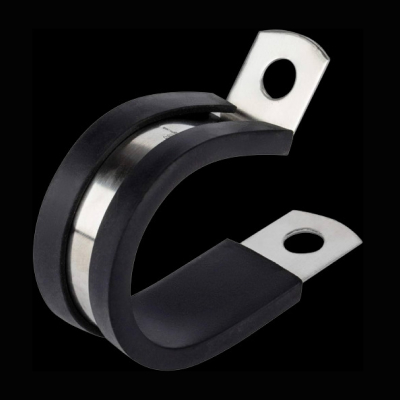
C TYPE RUBBER CLAMP
C Type Rubber Clamp for Controlled, Cushioned Support
A C type rubber clamp provides a compact method of holding a pipe, tube, conduit or similar service while placing a cushioning layer between the supported item and the clamp body.
The value of the rubber lining is not simply that it makes the clamp look more substantial. When it is correctly selected for the installation, the lining can help limit direct metal-to-pipe contact, reduce rattling, accommodate small surface variations and protect the supported service from avoidable marking or abrasion. The metal portion supplies the restraint, while the rubber interface helps create a more controlled contact surface.
This makes a rubber-lined C clamp relevant to contractors, fabricators, maintenance teams, equipment builders and procurement departments working with pipework, mechanical services, electrical containment and general industrial assemblies. The final suitability, however, depends on considerably more than the words “C type.” Pipe outside diameter, clamp opening, band width, metal thickness, fixing arrangement, rubber compound, lining thickness, surface finish and operating environment should all be considered before an order is approved.
Shree OSR Enterprises supports requirement-led enquiries for C type rubber clamps and related industrial fastening products. Instead of relying on a generic name alone, buyers can share a drawing, sample, bill of materials or a clear dimensional requirement. This helps distinguish a clamp that merely appears similar from one that is commercially aligned with the intended installation.
Buyers comparing pipe-support arrangements can also review the pipe fittings product category , the U clamps range and the clevis hanger clamp . These products perform different support functions and should not be treated as interchangeable purely because each can be associated with pipework.
- Cushioned pipe or conduit contact
- Reduced direct metal-to-surface contact
- Suitable for specification-led bulk enquiries
- Material and finish selected by application
How Does a C Type Rubber Clamp Work?
The clamp creates restraint around the supported service, while its rubber lining forms a separating and cushioning interface. Both parts must be appropriate for the movement, environment and mounting method.
The service is positioned
A pipe, tube or conduit is placed at the planned support point with enough clearance for the clamp, fixing and surrounding installation.
The lining makes contact
Rubber sits between the metal clamp and the supported surface, creating a softer interface than unlined metal-to-metal contact.
The clamp applies restraint
The metal body and fixing arrangement retain the service in its intended position when installed according to the approved detail.
Movement is managed
Correct spacing and tightening help control unwanted displacement without assuming that every support point must rigidly lock the pipe.
Restraint and isolation are different functions
A rubber-lined C clamp combines two functional elements. The metal portion supplies the clamp’s form and mechanical restraint. The lining alters the contact condition between that metal and the pipe, tube or conduit. This separation may help reduce surface marking, minor vibration transfer and noise caused by direct hard-surface contact. The lining can also improve the conformity of the contact area when small dimensional or surface variations exist.
Rubber does not automatically turn the clamp into an engineered vibration isolator. Performance depends on the rubber compound, hardness, thickness, contact area, compression, temperature and frequency of movement. A thin lining used to protect a pipe surface should not be assigned the same performance as a purpose-designed anti-vibration mounting system. Where vibration isolation is critical, the project engineer should define the required performance and approve the complete support assembly.
Tightening also requires control. If a clamp is left too loose, the service may move, rattle or slip. Excessive tightening can heavily compress the rubber, distort a light pipe or remove the clearance required for thermal movement. The objective is not to apply the greatest possible force; it is to achieve the restraint specified for that support location.
Pipework frequently expands and contracts as operating temperatures change. A system may therefore contain fixed points, guided points and supports that permit defined movement. The clamp must be coordinated with the support design instead of being selected in isolation. Buyers evaluating alternative arrangements can read the clevis hanger versus U-clamp comparison and review the CPC CAN pipe clamp for other pipe-support configurations.
Anatomy of a C Type Rubber Clamp
Two clamps with a similar outline may behave differently because of their dimensions, metal, rubber interface, fixing detail and finish. Understanding these elements helps buyers prepare a clearer enquiry.
Clamp body
The body forms the C-shaped retaining profile. Its internal opening, width, thickness and geometry should correspond with the supported item and the intended level of restraint.
Rubber contact layer
The lining creates the cushioned interface. Its material, hardness, thickness and retention method influence how it responds to compression, heat, oils, weathering and repeated movement.
Edges and return profile
Edge condition affects installation handling and contact with the rubber. Profile consistency is important because sharp or poorly formed areas can damage the lining or supported surface.
Fastening points
Holes, slots, ears or other fixing features connect the clamp to its fastener or support. Their dimensions must coordinate with the selected bolt, screw, bracket or channel accessory.
Closure hardware
Where the configuration includes a bolt, screw, nut or washer, that hardware should be compatible with the clamp dimensions, installation access and required tightening method.
Protective finish
A coating or selected base metal helps address the surrounding environment. Finish choice should reflect moisture, indoor or outdoor exposure and the expected service conditions.
Why nominal pipe size is not enough
Pipe clamps are commonly requested using a familiar trade or nominal pipe size. That information may be a useful starting point, but the clamp physically interfaces with the pipe’s actual outside diameter. Nominal size and outside diameter are not always the same, and pipes described by the same nominal size can differ by material or product system. Insulation, sleeves, protective wrapping and external coatings can further change the diameter at the support point.
A buyer should therefore state whether the clamp will contact a bare pipe, a coated pipe or the outside of an insulation system. If it is intended to fit around insulation, the complete outside diameter and insulation-support detail become important. Compressible insulation should not be treated as though it were a rigid structural surface unless the approved design specifically permits that arrangement.
Clamp width and metal thickness also matter. A wider profile may spread contact across a larger area, while the material thickness influences stiffness and formability. These variables cannot be chosen from visual preference alone because a thicker or wider clamp is not automatically suitable for every mounting detail. Required clearance, supported load, access and connection hardware must be considered together.
The fixing interface deserves the same attention. Hole diameter, slot length, fastener size, edge distance and available tool access can determine whether the clamp can actually be installed as planned. Related components such as industrial hex bolts , square washers and slotted C channel should be specified as coordinated parts rather than added after the clamp has already been selected.
If an existing sample is being replaced, record the pipe outside diameter, clamp internal opening, band width, metal thickness, hole dimensions and overall profile. A photograph with a scale can assist initial identification, but a photograph alone should not replace a dimensioned drawing or physical sample when fit is critical.
For a clearer commercial enquiry: send the actual outside diameter, clamp dimensions, metal, rubber requirement, finish, quantity and delivery location.
Submit Your RequirementSelecting the Rubber Lining for the Service Environment
The word rubber does not identify one universal material. Different elastomer families respond differently to weather, heat, oil, water, chemicals and long-term compression. The required compound should therefore be stated or selected from actual service conditions.
EPDM lining
EPDM is frequently considered for outdoor and general building services because suitable formulations can provide useful resistance to weathering, ozone and water exposure.
- Outdoor or weather-exposed installations
- Water-related building services
- Ozone and ageing considerations
- Not automatically suitable for oils or fuels
Neoprene lining
Neoprene is often evaluated where buyers need a general-purpose cushioning material with a practical balance of weathering and moderate oil-resistance characteristics.
- General industrial support applications
- Moderate environmental exposure
- Equipment and mechanical assemblies
- Grade-specific compatibility still required
Other elastomers
Nitrile, silicone and other compounds may be considered when oils, fuels, elevated temperatures or specialised operating conditions make a general-purpose lining unsuitable.
- Nitrile for selected oil-related conditions
- Silicone for specified temperature demands
- Application-specific chemical compatibility
- Availability and approval must be confirmed
Before naming a compound
Define what the lining will encounter
A material name is useful only when it is connected to a realistic exposure profile.
Compound, hardness and thickness work as a system
Choosing between EPDM, neoprene, nitrile or another elastomer is only the beginning. Each material family can be manufactured in different formulations and hardness levels. Two black rubber linings may look identical while providing different resistance to heat, oil, weathering or compression. Colour and appearance are therefore not reliable methods of confirming a rubber compound.
Hardness affects how readily the lining conforms and compresses. A softer lining may accommodate small surface variations more easily, but excessive compression or movement may shorten its useful life. A harder lining may resist deformation differently but provide less conformity. The correct choice depends on the supported surface, contact pressure, vibration and intended service—not on a universal rule that softer or harder is always better.
Lining thickness also changes the final internal opening of the clamp. If the metal body is ordered without accounting for the rubber thickness, the assembled clamp may be too tight for the pipe. Conversely, an opening selected too generously may fail to provide the planned restraint. Dimensions should therefore indicate whether they refer to the unlined metal profile or the usable internal diameter after the rubber is fitted.
The method used to retain the rubber deserves attention. Depending on the product configuration, the lining may be mechanically captured, bonded, wrapped or formed to grip the clamp edges. It should remain correctly located during handling and installation. Any adhesive, where used, must also be compatible with the rubber, metal, temperature and surrounding environment.
Procurement teams should communicate the actual exposure rather than simply requesting an “oil-resistant,” “heat-resistant” or “weather-resistant” clamp. These phrases do not define a measurable performance level. Where a project follows an elastomer specification, include the required designation and acceptance documentation in the request for quotation. The closed-cell neoprene and neoprene foam sheet pages provide related material options, while the neoprene foam and rubber packing guide explains broader construction uses.
Compatibility warning: General material guidance cannot replace project-specific compatibility verification. Confirm the exact compound, grade, temperature range and chemical exposure with the approved technical data before installation.
Choose the Clamp Material and Finish Around the Environment
A rubber lining may protect the pipe-contact surface, but it does not protect every exposed part of the clamp. The metal body, edges, holes and fastening hardware must still be appropriate for the installation environment.
Mild steel
Mild steel offers practical formability and is commonly considered for general-purpose clamp construction. Because untreated mild steel can corrode, the requested protective finish and storage conditions should be stated.
- Commercially practical for many indoor applications
- Can be supplied with a specified protective finish
- Cut edges and formed areas require attention
- Not inherently corrosion-proof
Galvanized or coated steel
Zinc-based or other protective finishes may improve corrosion resistance when correctly selected and applied. The coating type, thickness, appearance and post-forming treatment should be clarified.
- Useful for selected damp or exposed locations
- Finish must suit fabrication and installation
- Fasteners should be compatible with the clamp
- Coated does not mean maintenance-free
Stainless steel
Stainless steel may be requested for demanding environments, hygiene-sensitive installations or long-term corrosion considerations. The grade must be specified because “stainless steel” does not identify one material.
- Grade selected around environmental exposure
- Surface contamination should be controlled
- Dissimilar-metal contact needs evaluation
- Grade and documentation affect pricing
Finish selection begins with exposure. An indoor plant room, outdoor service corridor, coastal facility, food-processing area and chemically aggressive production zone do not present the same corrosion risks. Buyers should describe moisture, cleaning chemicals, airborne salts, temperature and expected service life instead of requesting a vaguely “rust-proof” product.
Electroplated zinc can be suitable for certain controlled applications, while hot-dip galvanizing may be considered where a more substantial zinc coating is required. These processes do not produce identical dimensions or surface characteristics. A coating added after forming can affect holes, threads and fit. Conversely, cutting or drilling previously coated material can expose unprotected metal. The intended manufacturing route should therefore be coordinated with tolerances and finish requirements.
Stainless steel should also be specified by grade and environment. A grade suitable for a dry interior should not automatically be selected for chloride-rich or chemically aggressive exposure. Surface cleanliness matters because contamination with carbon-steel particles can create local staining or corrosion. If appearance is important, state the required surface finish and acceptable handling condition.
The clamp, bolt, nut, washer, channel and bracket form an assembly. Mixing metals without reviewing galvanic compatibility can create accelerated corrosion when moisture is present. Related components such as stainless steel bolt, nut and washer sets, mild-steel fastener sets and slotted C channel should be chosen as coordinated hardware.
Applications for C Type Rubber Clamps
A C type rubber clamp can support several kinds of services, but its dimensions, mounting arrangement and materials must be selected for the specific application.
Cushioned support for selected water pipes, drainage services and related building pipework where the approved support detail calls for a rubber-lined clamp.
Possible use around selected heating, cooling and ventilation-associated pipework, subject to temperature, condensation and insulation requirements.
Retention of compatible conduit or protective tubing where dimensions, electrical requirements and fixing arrangements have been coordinated.
Organisation and restraint of tubes or lines on machines, skids and fabricated assemblies where vibration and maintenance access are considered.
Only where the clamp and complete support arrangement are approved for the applicable fire-protection design; a general clamp must not replace listed hardware.
Integration with brackets, channels and frames when the connection detail, fastener size and load path are defined by the responsible designer.
The same clamp should not be assumed suitable for every service. A cold-water line may produce condensation. A hot pipe may expose the rubber to sustained temperature. Refrigeration pipework may include insulation and vapour-control layers. Industrial tubing may encounter oil, cleaning chemicals or continuous vibration. These conditions change the selection process even when the outside diameters appear identical.
In building services, clamps are commonly installed from walls, ceilings, frames or support channels. The substrate and connection method determine how restraint reaches the building structure. A strong clamp attached to an unsuitable anchor or weak substrate does not create a reliable support. Anchor type, embedment, edge distance and base-material condition must be checked separately.
For overhead installations, all components require appropriate design and installation controls. The clamp should not be used as fall-arrest equipment or as an improvised lifting accessory. Where failure could endanger people, damage critical equipment or interrupt essential services, engineering approval and documented inspection are especially important.
Applications involving gas, fire protection, hazardous fluids, pressurised services or seismic restraint may be governed by project specifications and regulatory requirements. A generic product description cannot establish compliance. For fire-service support options, review the sprinkler hanger clamp and the accompanying sprinkler hanger clamp guide. Gas-service buyers can consult the gas pipe clamp selection guide.
Shree OSR Enterprises can evaluate a commercial enquiry when the buyer identifies the supported service, outside diameter, operating environment, quantity and required delivery location. Project drawings or an approved bill of materials provide a better foundation than selecting solely from a product photograph.
How to Specify the Correct C Type Rubber Clamp
A complete specification reduces clarification time and the risk of receiving a clamp that resembles the requirement but does not fit the installation. Use actual dimensions wherever possible and identify whether each value applies to the metal body, rubber lining or completed assembly.
| Required information | What to provide | Why it matters |
|---|---|---|
| Supported item | Pipe, tube, hose, cable or conduit type | Clarifies the intended use and contact surface. |
| Outside diameter | Measured OD at the actual support point | Determines the usable internal clamp dimension. |
| Clamp profile | Drawing, sample or dimensioned sketch | Avoids ambiguity around the term “C type.” |
| Band dimensions | Width and metal thickness | Influences stiffness, contact area and fit. |
| Fixing details | Hole, slot, bolt and mounting dimensions | Allows coordination with brackets or channels. |
| Metal and grade | MS, specified stainless grade or approved option | Connects strength and corrosion decisions to the project. |
| Surface finish | Plain, plated, galvanized or other requirement | Helps address exposure and appearance. |
| Rubber lining | Compound, hardness, thickness or exposure data | Influences temperature and chemical compatibility. |
| Quantity | Trial, batch, annual or project quantity | Affects production, packaging and commercial pricing. |
| Delivery | City, schedule and required documentation | Supports a realistic quotation and lead time. |
Measure the service
Measure the actual outside diameter with a suitable instrument. Do not automatically convert a nominal pipe designation into a clamp diameter.
Define the environment
Record temperature, moisture, chemicals, sunlight, vibration, insulation and whether the clamp will be installed indoors or outdoors.
Confirm the connection
Identify how the clamp attaches to the wall, bracket, frame or support channel and which fastener dimensions are required.
When measuring a replacement clamp, do not record only the largest visible dimension. Measure the internal opening, overall height, band width, material thickness, hole diameter, hole centres, slot length and rubber thickness. Note whether the old lining has permanently compressed or deteriorated, because a worn sample may no longer represent its original dimensions.
Photographs are helpful when they show the complete clamp, mounting point and a ruler or scale. However, perspective distortion can make photographs unreliable for final production dimensions. A marked drawing or physical sample remains preferable where fit is important.
If the supported pipe is insulated, provide the outside diameter over the insulation and explain whether the clamp contacts the insulation directly or uses a protective saddle or load-bearing insert. Compressing soft insulation can damage vapour barriers, create thermal bridges or reduce insulation performance.
For project purchasing, include the drawing revision, item number and required inspection documentation. This makes it easier to match a quotation to the correct bill-of-material line. General guidance on preparing industrial fastener requirements is available in the industrial fastener selection checklist.
C Type Rubber Clamp vs Other Pipe-Support Options
No single clamp style is best for every installation. Compare the way the service is supported, the direction of restraint, installation access and required movement before choosing a product.
C type rubber clamp
Provides compact, cushioned restraint around a compatible pipe, tube or conduit. Its precise form and fixing arrangement must be confirmed from a drawing or sample.
Consider for compact cushioned restraintU-clamp or U-bolt arrangement
Wraps around the service with two threaded legs or fixing points. It may suit base-mounted arrangements but can create concentrated contact if incorrectly tightened.
Consider for defined base or bracket fixingSplit pipe clamp
Usually opens into sections and closes around the pipe. This can simplify installation around an existing service and provide more extensive circumferential contact.
Consider where opening access is valuableClevis hanger
Suspends horizontal pipework from above and allows the pipe to sit within a lower support loop. Its load path and movement characteristics differ from compact clamps.
Consider for suspended horizontal servicesConduit clamp or strap
Designed for compatible electrical conduit and mounting arrangements. Electrical code, bonding and listed-product requirements may apply.
Consider for correctly matched conduitSprinkler hanger
Intended for fire-protection support arrangements where the applicable design, approvals and installation rules must be followed.
Consider only for approved fire-service useA product should not be substituted because it has a similar diameter or lower unit cost. Changing the clamp can alter the load path, available movement, required anchor, installation time and inspection criteria. Substitutions should be reviewed against the original design intent.
A C type rubber clamp may be preferred when the buyer needs a relatively compact profile and a cushioned contact surface. A split clamp may provide easier installation around an existing pipe. A clevis hanger may be more appropriate for suspended horizontal pipework. A U-clamp may work better against a base plate or fabricated bracket. These are functional differences, not merely differences in appearance.
Review the clevis hanger versus U-clamp guide, conduit clamp, U clamps and clevis hanger clamp before finalising a support arrangement.
Installation and Inspection Guidance
Correct product selection can still be undermined by poor handling, misalignment or uncontrolled tightening. Installation should follow the approved drawing, project specification and fastener instructions.
Check the clamp body, rubber lining, holes, coating and supplied hardware for damage, distortion or contamination.
Match the product, size, material and finish to the drawing or bill of materials before taking it to the support point.
Position the service without forcing it into the clamp. Confirm that the mounting bracket and fixing are properly aligned.
Use the specified hardware and tightening method. Avoid crushing the pipe, cutting the lining or fully flattening the rubber.
The contact area should be clean before the clamp is fitted. Metal chips, welding spatter, sharp debris and damaged coating can cut the rubber or create local pressure points. If the pipe surface includes a protective coating, check that it has cured and that the rubber is chemically compatible with it.
Do not pull badly misaligned pipework into position using the clamp fastener. This introduces unintended stress into the pipe, clamp and support. Correct the alignment or obtain engineering direction. The clamp should also sit squarely against its bracket or fixing surface rather than being twisted to compensate for poor fabrication.
Tightening requirements depend on the clamp configuration, fastener and supported service. “Hand tight” is not a measurable specification, while applying the highest possible torque can damage the assembly. Where a torque value is required, it should come from the approved product or project documentation and be applied with a suitable calibrated tool.
After installation, confirm that the rubber remains correctly positioned, the pipe is not visibly distorted and the clamp does not interfere with insulation, valves, joints or maintenance access. Check that threaded engagement is adequate and that washers or locking components have been installed as specified.
Periodic inspection frequency should reflect the consequences of failure and the service environment. Look for loose hardware, pipe movement, hardened or split rubber, coating breakdown, corrosion staining and deformation. A clamp affected by fire, chemical spillage, impact or unauthorised modification should be evaluated rather than simply retightened.
Installation practices to avoid
- Using the clamp to pull misaligned pipework into position
- Substituting bolt sizes without checking the hole and connection
- Painting over damaged or contaminated rubber
- Grinding or welding near the lining without protection
- Reusing visibly stretched, cracked or heavily compressed components
- Treating an ordinary clamp as lifting, seismic or fall-protection hardware
Procurement Support for Samples, Projects and Bulk Requirements
Efficient industrial purchasing depends on matching the commercial quotation to an identifiable technical requirement. A concise but complete enquiry helps avoid repeated clarification and unsuitable substitutions.
Drawing-led enquiries
Send the latest drawing revision and identify critical dimensions, tolerances, metal, coating, rubber compound and required documentation.
Sample-based requirements
Provide a physical sample where possible, but explain whether it is unused or taken from service. Worn rubber and corroded metal may not represent original specifications.
Trial quantities
A trial or pre-production sample may help confirm fit before a large order. Approval responsibilities and any dimensional checks should be agreed in advance.
Project and repeat orders
Include item codes, quantities by size, packaging needs, delivery schedule and destination so that commercial planning reflects the complete requirement.
Unit price alone does not show the total procurement cost. An incorrectly specified clamp can create site delays, rework, emergency transport and replacement expense. Quotations should be compared on equivalent scope: material, dimensions, finish, lining, hardware, documentation, packing and delivery terms.
If alternative materials or finishes are commercially acceptable, state that alternatives may be quoted separately. This keeps the original requirement visible while allowing an informed comparison. An alternative should never be silently treated as equivalent where the grade or performance affects project approval.
For mixed-size orders, prepare a schedule with one line for each clamp size. Use a stable item reference and avoid placing multiple conflicting dimensions in a single description. If drawings are revised, issue the new revision clearly and withdraw obsolete copies from the purchasing package.
Packaging requirements may matter when clamps include delicate coatings, loose hardware or rubber linings that can deform in storage. State whether pieces must be individually packed, grouped by size, labelled by item code or supplied in project-specific lots.
Shree OSR Enterprises supplies industrial fasteners, clamps, threaded products, anchors and support hardware for commercial requirements across India. The company’s role is to quote the stated requirement and clarify missing inputs—not to replace the project designer’s responsibility for support spacing, loads or regulatory approval.
Prepare your C type rubber clamp enquiry
Send the supported diameter, clamp drawing or sample, metal, rubber requirement, finish, quantity, delivery city and requested timeline.
Request a Commercial QuoteCommon C Type Rubber Clamp Specification Mistakes
Most purchasing problems begin with missing or assumed information. The following checks can prevent avoidable fit, compatibility and approval issues.
Record the actual outside diameter at the support point, including any coating, sleeve or approved insulation arrangement.
Rubber appearance does not confirm compound, hardness, chemical resistance or temperature capability.
Perspective and scale can hide important differences in width, hole position, profile and metal thickness.
A correctly sized clamp may still be unusable if its holes, slots or fasteners do not match the bracket or channel.
Define the environment and required metal or coating rather than relying on an undefined marketing phrase.
Excessive force can crush the lining, damage coatings, distort light pipework or prevent required movement.
Fixed, guided and sliding support points serve different functions and should follow the approved pipe-support design.
A U-clamp, split clamp, conduit strap and clevis hanger cannot be treated as equivalent solely because the diameter matches.
Related Pipe Supports, Fasteners and Technical Guides
C Type Rubber Clamp FAQs
What is a C type rubber clamp?
It is a metal clamp with a C-shaped or commercially described C-type profile and a rubber contact layer. It is used to restrain compatible pipes, tubes, conduits or similar services while limiting direct metal contact. Because the name can describe different configurations, the required profile should be confirmed through dimensions, a drawing or a sample.
What information is required for a quotation?
Provide the supported item, actual outside diameter, clamp width and thickness, hole or slot dimensions, metal, finish, rubber requirement, quantity, delivery location and required timeline. A drawing or sample is recommended when fit is critical.
Is EPDM always the best rubber lining?
No. EPDM may be considered for weather, ozone and selected water-related exposure, but it is not universally suitable for oils, fuels, chemicals or every temperature. Select the compound around the complete operating environment.
Can neoprene be used for the lining?
Neoprene may be considered for selected general industrial conditions, but the grade, hardness, temperature and chemical compatibility must be confirmed. The material name alone does not establish performance.
How is the correct clamp size selected?
Start with the actual outside diameter at the support point. Account for rubber thickness, coating, insulation and any sleeve or protective layer. Do not rely solely on nominal pipe size.
Does the rubber lining stop all vibration?
No. It may reduce minor contact noise and vibration transmission, but a lined clamp is not automatically a performance-rated vibration isolator. Critical vibration control requires an engineered support or isolation system.
Can the clamp be installed outdoors?
Outdoor suitability depends on the metal, coating, rubber compound, drainage and exposure. Sunlight, ozone, rain, pollution, salts and temperature variation should be included in the specification.
Can stainless steel be supplied?
Stainless steel may be considered subject to the required configuration and commercial availability. State the required stainless grade and environment instead of requesting unspecified stainless steel.
Is a C type rubber clamp suitable for insulated pipe?
Only when the support arrangement is designed for that insulation system. Provide the finished outside diameter and identify any load-bearing insert, protective saddle or vapour barrier. Soft insulation should not be unintentionally crushed.
Can this clamp support fire-protection pipework?
Only if the complete product and support arrangement meet the applicable approved design and project requirements. A general rubber clamp should not replace required listed or approved fire-protection hardware.
Can the clamp be used for lifting?
No general-purpose pipe clamp should be used as lifting, fall-protection or rigging hardware unless it is specifically designed, rated and approved for that function.
How should installed clamps be inspected?
Check for loose hardware, pipe movement, displaced or cracked rubber, deformation, coating damage and corrosion. Inspection frequency should reflect the environment and consequences of failure.
Request a C Type Rubber Clamp Quote
Send Shree OSR Enterprises your pipe or conduit outside diameter, clamp drawing or sample, metal, rubber lining requirement, finish, quantity and delivery location. Clear specifications help the team prepare a more relevant commercial response.