
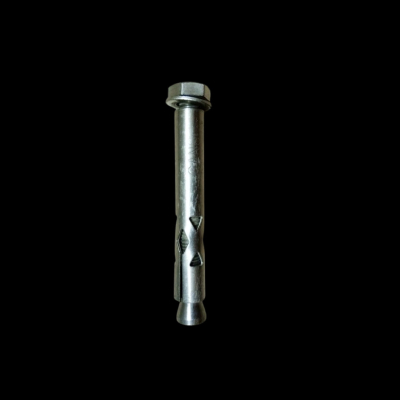
SLEEVE ANCHOR
Mechanical expansion fixing
Specify a sleeve anchor around the connection—not just the diameter
Shree OSR Enterprises supplies sleeve anchors for contractors, fabricators, MEP installers, maintenance teams, distributors and industrial procurement buyers across India. A useful enquiry identifies the base material, fixture, load direction, diameter, length, material, finish, quantity and delivery location.
A sleeve anchor is a pre-assembled mechanical expansion fastener used to attach a fixture to a drilled base. Its central bolt or stud passes through an expandable metal sleeve. When the nut or bolt is tightened, a tapered element draws into the sleeve and forces part of that sleeve against the wall of the hole. The resulting contact creates the mechanical grip that resists movement.
That simple description does not make every sleeve anchor interchangeable. Products can differ in outside diameter, bolt diameter, sleeve length, expansion geometry, thread, head style, washer arrangement, steel grade, coating, embedment and approved base-material scope. Two anchors sold under the same nominal size may therefore require different holes, tightening procedures and design values.
Sleeve anchors are often considered for through-fixing brackets, frames, rails, supports and other fixtures to suitable concrete or masonry. Whether an exact product is acceptable in solid brick, hollow block, natural stone or a particular grade of concrete must be checked from its technical data and the project design. The ability to insert an anchor into a drilled hole is not proof that the connection is safe.
This page is intended to help buyers prepare a technically clearer request for quotation. It does not substitute for an engineer’s design, an approved anchor schedule, project specification, test report or the installation instructions issued for the selected product.
How a sleeve anchor develops grip
The anchor works as an assembly. Reliable performance depends on matching its components to the drilled hole, fixture and base—not on the bolt alone.
Head, nut and washer
The visible end clamps the fixture. Depending on the product, it may use a hex nut, hex bolt, countersunk head, round head or acorn-style finish. The washer distributes bearing against the fixture. Head choice affects access, appearance, protrusion and the tool used during setting.
Threaded body
The central stud or bolt transfers the clamping action through the assembly. Its diameter should not be confused with the outside diameter of the sleeve. Thread quality, usable thread length and steel class influence fit and installation, while corrosion compatibility matters across every metal component.
Expandable sleeve
The sleeve occupies a substantial part of the drilled hole and expands over a defined zone. This broader contact is one reason sleeve anchors are considered for multiple masonry conditions. The exact unit and product approval still decide whether a specific brick or block application is allowed.
Cone or expander
Tightening draws the tapered element into the lower part of the sleeve. Controlled movement pushes the sleeve outward. Too little setting may leave inadequate expansion; excessive tightening can damage threads, deform the fixture or overstress weak masonry.
Start with the material receiving the anchor
“Wall” or “concrete” is rarely enough information. Confirm the actual substrate, its condition, thickness, void pattern, strength and distance to free edges before choosing a sleeve anchor bolt.
| Base material | Selection logic | Questions to resolve | Do not assume |
|---|---|---|---|
| Sound concrete | A common candidate for mechanical expansion fixing where the exact anchor supports the concrete condition and required load. | Concrete strength, cracked or uncracked condition, member thickness, reinforcement, embedment, edges, spacing and drilling method. | That every sleeve anchor is approved for cracked concrete, seismic demand or overhead loading. |
| Solid clay brick | A sleeve’s expansion area may suit selected solid masonry, provided the product data permits it and the unit is sound. | Brick strength, age, cracks, edge distance, joint location and whether drilling can avoid damaging the unit. | That values measured in concrete apply to brick, or that a mortar joint equals the brick unit. |
| Concrete block / CMU | Some sleeve anchors are intended for selected solid or hollow block. Position relative to webs and cells is important. | Solid or hollow unit, face-shell thickness, grout condition, anchor location and product approval. | That any point on a hollow unit provides the same resistance. |
| Natural stone | Possible only after assessing the stone type, integrity, thickness and splitting risk. Project-specific testing may be appropriate. | Stone geology, bedding, cracks, edge distance, finish sensitivity and consequence of local breakage. | That all stone behaves like concrete or that visible soundness proves internal integrity. |
| AAC / lightweight block | Usually needs a fixing specifically designed and documented for low-density cellular material. | Block density, manufacturer guidance, fixture load and approved specialist anchor. | That a general-purpose expansion sleeve will develop reliable grip. |
| Plaster, tile or render | These layers normally count as non-structural build-up; the anchor must reach a suitable structural base behind them. | Finish thickness, compressibility, stand-off, waterproofing and substrate depth. | That the decorative layer can carry the fixing or may be included as effective embedment. |
Verify the substrate rather than choosing by habit
On refurbishment work, drawings may not reflect the material found on site. A coating can conceal brick, block, concrete, plaster or a cavity. A preliminary survey, trial drilling or engineer-approved proof-testing plan can reveal conditions that change anchor selection.
For repetitive installations, record the acceptable drilling location, hole-cleaning method, setting tool, torque control, inspection and treatment of rejected holes. This converts a product choice into a repeatable site process.
Build the size from embedment, fixture thickness and setting allowance
Searches such as “M8 sleeve anchor,” “M10 sleeve anchor bolt” or “M12 sleeve anchor price” identify only part of the requirement. The selected overall length must place the expansion zone at the intended depth while accommodating everything between the base and the nut or head.
1. Confirm nominal diameter
Diameter affects the hole, steel area, expansion geometry and available product range. Use the design schedule or verified technical data. Do not enlarge a fixture hole or substitute a diameter on site without approval.
2. Establish embedment
Effective embedment is the depth over which the installed anchor develops its action in the structural base. It is not automatically equal to overall length or drilled-hole depth. Observe minimum member thickness and avoid hidden services and reinforcement.
3. Measure the fixture
Include the actual plate, bracket or frame thickness. If the assembly uses packers, shims, grout, insulation or a stand-off, identify them separately; compressible layers can alter clamping and bending behaviour.
4. Allow for nut and washer
A stud-and-nut version needs adequate thread for the washer, nut and required engagement. It must also avoid excessive protrusion where appearance, clearance or injury risk matters.
5. Check usable thread
Overall length does not guarantee that every part is threaded. Confirm where the sleeve ends, where the nut can travel and whether the fixture can be fully clamped before the thread or sleeve limits movement.
6. Match the hole data
Use the drill diameter, minimum depth and cleaning procedure for the exact supplied product. Some sleeve anchors use a hole matching the anchor’s outside diameter, but that rule must be confirmed rather than assumed from nominal bolt size.
Example of a clear enquiry
“Sleeve anchor, M10 × 100 mm overall, hex-nut head, zinc-plated carbon steel; fixing 12 mm bracket to sound concrete; 800 pieces; individual batch identification required; delivery to Pune.” Add the drawing and required design data where applicable.Example that needs clarification
“Need strong 10 mm anchor, 1,000 pcs, best price.” It does not identify the sleeve outside diameter, length, base, load, fixture, steel, finish or delivery city, so suppliers may quote materially different products.Select steel and surface protection for the real environment
“Stainless” and “galvanized” are not complete specifications. Exposure, design life, cleaning chemicals, moisture, chloride, temperature, contact metals and the coating applied to every component should be reviewed together.
MS / carbon steel
Often selected for economical, protected indoor service where the specified mechanical class and corrosion system are appropriate.
Confirm: steel class, finish, plating thickness, sleeve and washer material—not simply “MS.”Zinc plated
A thin plated finish is commonly considered for dry or controlled interiors. Its suitability depends on coating specification and service conditions.
Do not treat as: a universal outdoor or coastal corrosion solution.Hot-dip galvanized
HDG may be evaluated for exterior and industrial exposure where coating thickness, thread fit and the complete assembly are compatible.
Confirm: actual coating process and whether dimensions allow for it.SS304 / SS316
Stainless options are considered for corrosion resistance. SS316 is often evaluated where chloride or coastal exposure is more demanding.
Confirm: alloy, strength class, traceability and all-component compatibility.Corrosion is a system issue
Moisture can collect behind a bracket even when the visible anchor looks dry. Dissimilar metals can create galvanic interaction. Damaged coating at threads, cut edges or tools may become a local corrosion point. Sealants can trap water or contain incompatible chemicals. State whether the connection is indoors, sheltered outdoors, fully exposed, coastal, in a wash-down zone, near process chemicals or subjected to high humidity.Stainless needs correct handling
Stainless-steel components can be contaminated by carbon-steel tools or storage. Mixed grades in an unmarked container defeat traceability. Use compatible tools and components, keep material separated, protect the surface and use the specified tightening procedure. Stainless selection does not remove the need to confirm mechanical performance and base compatibility.Where sleeve anchors may fit—and where a different system may be needed
Applications are examples, not automatic approvals. The fixture name does not determine the anchor; the forces, base, geometry, exposure and consequence of failure do.
Frames and brackets
Metal frames, wall brackets and general supports can benefit from through-fixing, but plate-hole clearance, stand-off, eccentricity and edge distances must be considered.
MEP supports
Pipe, cable-tray, duct and service brackets require coordination with vibration, fire strategy, overhead risk and the approved support design.
Rails and barriers
Handrails, guardrails and protective barriers can generate high leverage and dynamic action. They are not “general fixing” work; use a designed and verified connection.
Equipment mounting
Light equipment, cabinets and machine accessories may be candidates. Rotating machinery, impact or repeated vibration needs a specialist review and maintenance plan.
Signage and façade accessories
Wind suction, fatigue, water entry and public safety can govern. Façade and overhead signage demand an approved product and substrate-specific design.
Fit-out and refurbishment
Sleeve anchors can offer a practical retrofit connection when the existing base is verified. Old masonry, hidden cavities and unknown finishes make survey work essential.
Pause the sleeve-anchor selection when…
- the substrate is unknown, weak or cracked;
- the fixing is close to a free edge or another anchor;
- the base is AAC or low-density masonry;
- the connection is overhead or life-safety critical;
- the design requires seismic or cracked-concrete approval;
- the fixture creates substantial stand-off or bending;
- there is heavy vibration, fatigue or impact;
- reinforcement or services obstruct the planned hole;
- a fire-resistance rating is required;
- corrosive exposure is not defined;
- the anchor spins or the hole becomes oversized;
- no product-specific data can be identified.
A controlled installation sequence
Follow the instructions supplied for the exact sleeve anchor and the approved project method statement. The sequence below explains the control points buyers and site supervisors should expect; product-specific values take precedence.
Verify the approved item
Match pack label, diameter, length, head, material, finish and batch with the schedule. Inspect for corrosion, damaged sleeves, missing washers, bent studs or poor threads. Keep mixed sizes out of the work area.
Mark an acceptable location
Use the drawing and survey information. Confirm edges, spacing, member thickness, reinforcement and concealed services. Moving a hole to avoid reinforcement can violate spacing or plate geometry, so obtain approval.
Use the specified drilling method
Select the stated drill diameter and a suitable, serviceable bit. Drill perpendicular unless the design says otherwise. A worn bit, excessive wobble or unintended diamond drilling can change hole-wall characteristics.
Control hole depth
Mark the bit or use a depth stop. The hole must accept the required embedment plus any stated allowance. Avoid blindly drilling deeper where reinforcement, prestressing or services may exist.
Clean the hole
Remove dust and debris using the product-approved sequence and equipment. Residue can block full insertion, alter expansion and give misleading setting feedback. Protect workers from silica dust in accordance with site controls.
Insert without damaging the anchor
Where through-fixing is allowed, align the fixture hole and insert the assembled anchor to the prescribed depth. Set the nut in the recommended position before tapping so the thread is protected. Use only permitted tools.
Tighten as specified
Bring the fixture into full contact and apply the product’s defined setting action or torque with suitable equipment. Do not use an arbitrary number of turns or maximum tool power as a substitute for instructions.
Inspect and record
Check seating, washer bearing, thread engagement, fixture alignment and signs of base damage. Record location, anchor identification and installation checks when the quality plan requires traceability.
When an installation goes wrong
If the anchor spins, the nut does not tighten, the fixture remains loose, the sleeve rises from the hole, the masonry cracks or the hole is misplaced, stop. Do not fill the gap with scrap metal, resin or an oversized anchor unless an approved repair detail permits it. Mark the location, notify the responsible supervisor and follow the engineer-approved rejection and relocation procedure.Sleeve anchor, wedge anchor, Rawl bolt or chemical anchor?
Trade names overlap, but the mechanisms are different. Compare complete systems before authorising a substitution.
| Anchor family | How it engages | Typical selection logic | Key distinction |
|---|---|---|---|
| Sleeve anchor | A sleeve around much of the bolt or stud expands as a cone is drawn into it. | Versatile through-fixing in suitable concrete and, for some products, selected solid or hollow masonry. | Base scope, sleeve length, head styles and expansion distribution vary by product. |
| Wedge anchor | A clip near the tapered end of a stud expands against the hole wall as the nut is tightened. | Permanent male-stud fixing in suitable solid concrete, often where high concrete-anchor performance is required. | Many wedge anchors are concrete-only; do not transfer their loads or drilling data to a sleeve anchor. |
| Rawl / shield bolt | A segmented shield expands around a central bolt, cone, hook or eye arrangement. | General mechanical anchoring in the base materials supported by the particular shield design. | “Rawl bolt” is often used generically. Identify the actual configuration instead of ordering by nickname. |
| TAM anchor | A compact metal body or shield expands through its compatible bolt or setting action. | Selected concrete, masonry or stone fixing, sometimes with a female-body arrangement. | Its fixture interface, outside diameter and setting method are not automatically the same as a full sleeve anchor. |
| Chemical anchor | Resin bonds a threaded rod, rebar or insert along a correctly prepared hole after curing. | Engineered anchoring where a qualified resin system, substrate, rod and installation method fit the design. | No mechanical expansion during resin placement, but strict cleaning, temperature, cure and component controls apply. |
| Drop-in anchor | An internally threaded shell is set below or flush with the surface using a defined setting tool. | Female threaded fixing in suitable solid concrete, including selected suspended services where approved. | Uses a separate bolt or rod and a displacement-controlled setting action; it is not a sleeve-bolt substitute. |
The conditions behind an anchor capacity
There is no responsible universal answer to “How much weight can an M10 sleeve anchor hold?” Capacity belongs to an identified product installed in a defined base and connection geometry under a stated design method.
Tension and shear
A hanging or overturning fixture can pull on the anchor; gravity, impact or lateral action can shear it. Combined loading requires interaction checks rather than comparing each force independently with a catalogue maximum.
Concrete or masonry condition
Strength, cracking, density, unit type, voids, weathering and moisture affect failure behaviour. Values developed in one substrate cannot be transferred to another.
Embedment and member thickness
Deeper is not automatically better. Embedment must remain within product data, while the base must be thick enough to develop the anchorage without rear-face breakout or drilling through.
Edges and spacing
Expansion and load spread through the base. A nearby free edge or adjacent anchor can reduce resistance and alter the governing failure. Observe product-specific minimums and design reductions.
Fixture behaviour
Thin plate can bend; oversized holes can reduce bearing; stand-off increases bending; slotted holes can change force transfer. The anchor cannot compensate for an inadequately designed fixture.
Installation and safety factors
Hole tolerance, cleaning, setting and torque affect performance. Published ultimate test values are not allowable working loads. Apply the applicable design method, factors and project requirements.
Why this page does not publish a generic load chart
A copied chart can appear helpful while creating a dangerous equivalence. Anchor dimensions, steel, sleeve geometry, embedment, torque and tested substrate differ between manufacturers. Ask for technical data tied to the quoted item, and let the responsible engineer assess it against the actual connection. For proof or pull testing, define the purpose, sample rate, test load, equipment, acceptance criteria and treatment of tested anchors before work begins.
Control what is quoted, delivered and installed
Quality is not established by a polished sample alone. The purchase description, approved submittal, batch identification, incoming inspection and site traceability should all refer to the same sleeve anchor.
Before placing the order
- Issue a line-item specification with diameter, length, head style, material, finish and quantity.
- Identify the base material and application, not only the trade name.
- Request drawings, technical data, test evidence or compliance documents needed by the project.
- Agree packaging quantity, labels, batch details and delivery programme.
- Clarify whether samples, first-article approval or project testing is required.
- Resolve alternatives in writing before price comparison or PO release.
When material arrives
- Match the delivery note, PO, pack labels and approved item.
- Check quantities and sample dimensions using suitable instruments.
- Confirm the complete assembly: bolt or stud, sleeve, cone, nut and washer as applicable.
- Inspect threads, coating, corrosion, deformation and mixed components.
- Quarantine unidentified, wet, damaged or nonconforming packs.
- Store by size, material and batch in dry, clearly labelled containers.
Dimensional checks
- Nominal anchor and sleeve outside diameter
- Overall length and sleeve length
- Thread diameter, pitch and usable engagement
- Nut size, washer diameter and thickness
- Head dimensions and fixture-hole compatibility
- Any drawing-specific tolerance or marking
Site-process checks
- Approved drill bit and calibrated torque equipment
- Installer briefing and accessible instructions
- Hole cleaning and dust-control method
- Location, edge and spacing verification
- Inspection records and test plan where required
- Defined response for failed or abandoned holes
What determines sleeve anchor price in India?
A single online rate can compare unlike items. Sleeve anchor price per piece changes with the physical specification, quality requirements, order size and delivery scope. A clear RFQ allows Shree OSR Enterprises to quote the requested product rather than guess.
Manage the anchor through its service life
Correct procurement and installation are only the beginning. Storage conditions, changes to the fixture, water ingress, corrosion, impact and vibration can affect a connection over time.
Store correctly
Keep packs dry, protected and identifiable. Separate carbon steel, coated steel and stainless grades. Do not return loose, unidentified site components to approved stock.
Inspect the connection
Use a risk-based maintenance interval. Look for corrosion, staining, cracking, movement, damaged sealant, loose fixtures and changes in operational loading.
Control alterations
Do not add loads, enlarge fixture holes, introduce packers or relocate equipment without reviewing the original anchorage design. A small geometry change can increase leverage.
Replace through an approved plan
An expanded sleeve anchor should not be removed and reused. A replacement hole must respect existing damage, edge distance and spacing; the abandoned hole may need defined repair.
Continue the anchor-selection process
Use related product pages to compare mechanisms and the technical references below to understand good anchoring practice. The quoted product’s own documents and the project engineer remain controlling.
Shree OSR product and buyer pages
Heavy-duty anchor category Wedge anchor Rawl bolt / shield anchor TAM anchor Chemical anchor Stainless-steel drop-in anchor Guide: sleeve anchor vs wedge anchor All industrial productsIndependent technical starting points
Hilti anchor-fastening technical guides Sleeve-anchor specification concepts Illustrated sleeve-anchor installation overview OSHA crystalline-silica safety informationExternal links are provided for general education. They may describe products, regulations or practices from other markets and must not be treated as approval, capacity data or installation instructions for a sleeve anchor supplied by Shree OSR Enterprises.
Sleeve anchor frequently asked questions
Concise answers for buyers, contractors and site teams. Exact product documentation and approved project requirements take priority.
What is a sleeve anchor?
A sleeve anchor is a post-installed mechanical expansion fastener. It normally includes a central bolt or threaded stud, an expandable metal sleeve, a cone or tapered expander, and a head or nut-and-washer arrangement. Tightening draws the cone into the sleeve, pressing it against the wall of a correctly drilled hole. The expanded assembly clamps a fixture to an approved concrete or masonry base. Product designs vary, so the term describes a family rather than one universal specification.
What are sleeve anchors used for?
They are used for selected brackets, frames, rails, MEP supports, equipment accessories, signs and general construction fixtures. Many installations use a through-fixing method in which the anchor passes through the fixture into the base. Suitability depends on load, substrate, edge distance, spacing, embedment, fixture geometry, exposure and consequence of failure. Structural, overhead and safety-critical applications require a verified product and engineered design.
Can sleeve anchors be used in concrete?
Many sleeve anchors are designed for concrete, but confirm whether the exact item is intended for the strength and condition present. Cracked concrete, uncracked concrete, thin members, lightweight concrete and deteriorated concrete do not create the same design case. Check approved data for drill diameter, embedment, torque, spacing, edges and member thickness. Do not use a load table from another brand or superficially similar anchor.
Can a sleeve anchor be installed in brick?
Some products are intended for suitable solid brick, but the brick must be sound and the anchor must be documented for that base. Brick can split under expansion, especially near edges, holes or cracks. Mortar joints generally have different and more variable properties than the units. Confirm whether the design requires installation in the brick body, what distances are needed and whether site testing is appropriate.
Can sleeve anchors work in hollow block?
Selected sleeve-anchor products may be used in identified hollow concrete masonry units, but performance depends on the block geometry, face shell, web or grouted cell and anchor location. An anchor placed over a void does not behave like one in solid concrete. Use product data for the particular masonry unit and avoid generic statements that all sleeve anchors work in all hollow block.
Are sleeve anchors suitable for AAC blocks?
AAC is a low-density cellular material and commonly requires an anchor specifically developed and tested for it. A general expansion sleeve can crush or damage the weak local material without creating dependable resistance. Confirm the AAC grade, fixture load and specialist anchor data. Do not transfer values from concrete, brick or concrete block.
What sleeve anchor sizes are available?
Market enquiries commonly include metric diameters such as M6, M8, M10 and M12, with other diameters and lengths depending on the product range and requirement. Availability should be confirmed against head style, sleeve outside diameter, overall length, material, finish, quantity and technical requirements. Nominal M-size alone is insufficient because bolt diameter and sleeve or hole diameter may be described differently across products.
How do I choose sleeve anchor length?
Start with the embedment required by the exact product and design. Add the fixture thickness, any approved non-structural build-up, washer and nut or head allowance, and the setting allowance defined by the product. Check usable thread and member thickness. Do not count plaster, render, tile, insulation or a void as effective structural embedment unless the engineered detail expressly addresses it.
Which drill-bit size should be used?
Use the drill-bit diameter stated for the supplied sleeve anchor. Many designs use a hole equal to the anchor’s outside diameter, but the nominal thread or bolt diameter may not equal that outside diameter. Product geometry differs. Use a suitable, serviceable bit, control drilling perpendicularity and depth, and follow the approved hole-cleaning procedure.
How deep should the hole be?
The hole must permit the defined embedment plus any product-specific extra depth for dust or insertion. The minimum and maximum conditions should come from the exact anchor instructions. Do not drill blindly deeper where reinforcement, prestressing tendons, pipes or electrical services may be present. A depth stop and substrate survey help control the work.
How tight should a sleeve anchor be?
Apply the setting action or installation torque specified for the exact product. “Hand tight plus a few turns” may appear in instructions for certain products but is not a universal rule. Under-tightening can leave inadequate expansion; excessive torque can strip threads, deform the fixture or split masonry. Use suitable controlled tools and observe any calibration requirements.
Why is the sleeve anchor spinning in the hole?
Possible causes include an oversized or damaged hole, incorrect bit, weak substrate, dust, incomplete insertion, mismatched components or an anchor unsuitable for the base. Stop instead of continuing to turn it. Remove load from the connection, identify the cause and follow an approved repair or relocation plan. Do not improvise by packing the hole or adding unrelated resin.
What is the difference between a sleeve anchor and a wedge anchor?
A sleeve anchor expands a sleeve around a significant part of the bolt or stud. A wedge anchor normally expands a smaller clip near the tapered end of a threaded stud. Wedge anchors are commonly associated with solid concrete; sleeve-anchor products may support a broader range of concrete and masonry bases. Their holes, embedments, installation values and capacities are not interchangeable. See the detailed sleeve vs wedge anchor guide.
Is a sleeve anchor the same as a Rawl bolt?
Not necessarily. “Rawl bolt” is widely used in trade language for shield-style expansion bolts and sometimes loosely for several masonry anchors. A sleeve anchor has its own sleeve, expander and fixture interface. Specify the actual assembly, head, diameter, length and data rather than relying on a generic site nickname.
Sleeve anchor or chemical anchor—which is better?
Neither is universally better. Sleeve anchors offer fast mechanical setting without resin cure time and can be convenient for through-fixing. A qualified chemical system bonds a rod or insert and may offer different embedment or edge solutions without installation expansion, but it depends heavily on resin selection, hole cleaning, temperature and full cure. The designer should compare the exact products and connection conditions.
Can sleeve anchors be used outdoors?
Only when the selected material and corrosion-protection system suit the exposure and design life. Basic zinc plating may be discussed for dry protected use, while HDG, SS304 or SS316 may be evaluated for more demanding conditions. Coastal chlorides, standing water, chemicals, contact with dissimilar metals and hidden moisture behind the fixture must be considered. Verify the entire assembly, not only the visible bolt.
What is an SS304 sleeve anchor?
It is a sleeve-anchor assembly specified with grade 304 stainless-steel components, subject to the supplier’s exact construction. SS304 provides useful general corrosion resistance, but the mechanical class, all-component grade, fabrication and environmental suitability still require confirmation. The phrase should not be assumed to mean every nut, washer, cone and sleeve is verified SS304 unless documentation states so.
When should SS316 be considered?
SS316 is often evaluated for chloride-bearing, coastal, humid or more corrosive exposures because of its alloy composition. Actual suitability depends on concentration, wetting, temperature, crevices, cleaning chemicals, contact metals and design life. A corrosion specialist may be needed for severe service. Stainless steel also needs compatible handling to avoid contamination.
Can a sleeve anchor be removed and reused?
An anchor that has been expanded, loaded, damaged or removed should not be installed again. Some fixtures or nuts may be removable, but the embedded sleeve has already been set and its condition cannot be assumed. Where frequent equipment removal is required, consider an approved female-threaded or other maintainable fixing arrangement during design.
Can I install a new anchor in the same rejected hole?
Not automatically. A rejected hole may be oversized, cracked or otherwise damaged. Installing a larger anchor can create additional expansion and edge effects. The engineer or approved procedure should define whether the hole is repaired, reused with a specific system or abandoned, and where a new location may be drilled while maintaining spacing.
How much load can an M10 or M12 sleeve anchor carry?
No single safe load applies to a nominal size. Capacity depends on the exact anchor, steel, sleeve geometry, embedment, base strength and condition, edge distance, spacing, fixture, load direction, installation and design factors. Request data tied to the quoted product and have the responsible designer evaluate the connection. Never use a competitor’s ultimate test number as an allowable working load.
Do sleeve anchors need pull-out testing?
Testing depends on the project specification, substrate uncertainty, anchor approval and consequence of failure. Proof testing is not a substitute for design, and a test can affect the tested anchor or surrounding base. Establish the sample rate, test method, calibrated equipment, proof load, duration, acceptance criteria, reporting and treatment of failures before installation begins.
What should I send to get a sleeve anchor price?
Send diameter × overall length, head configuration, material or grade, finish, quantity, base material, fixture thickness, application, documentation needs, delivery city and required date. Attach the BOQ, drawing or approved schedule. If you are comparing alternatives, state the original anchor and every technical criterion that the substitute must meet.
Does Shree OSR Enterprises supply sleeve anchors in bulk?
Shree OSR Enterprises handles commercial and project enquiries for industrial fasteners and anchors across India. Bulk availability, sizes, materials, finishes, packaging and delivery schedules are confirmed against the enquiry. Contact the team with a clear line-item specification so the quotation can state the offered scope and any required clarification.