
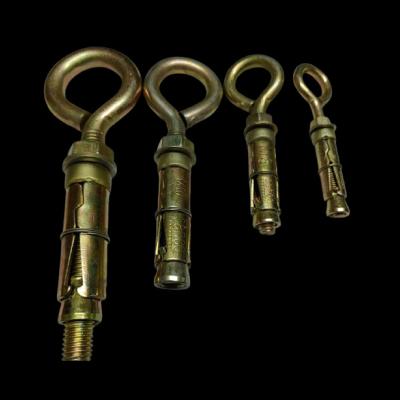
CAN EYE BOLT
Specify a CAN eye bolt by the connection—not by the product name alone
A CAN eye bolt combines a segmented expansion shield with a closed eye that can accept a compatible hook, shackle, chain or wire connection. Installed in an approved solid base, it creates a practical hanging point for selected building-services and industrial-support applications. The eye determines how the supported item connects; the expanding shield determines how the anchor engages the concrete or masonry.
That simple description is only the beginning of a responsible purchase specification. Diameter, shield geometry, embedment, base material, load direction, edge distance, spacing, corrosion exposure and installation method all influence whether a particular anchor is suitable. Two eye anchors that look similar in a catalogue may have different dimensions, material grades, finishes and verified performance. Shree OSR Enterprises therefore treats “CAN eye bolt” as a product family to be matched to a defined connection, rather than a universal fixing with one assumed capacity.
Where this anchor is commonly evaluated
- Suspended cable-management and selected MEP support arrangements
- Hanger points for light fixtures, signs and utility services where the approved detail calls for a closed eye
- Chain, wire or compatible connector attachment to suitable concrete or solid masonry
- Commercial, infrastructure, plant-room and industrial maintenance requirements
- New-build schedules, replacement work and bulk distributor enquiries
For a broader view of the family, browse heavy-duty anchors or read the detailed comparison of projection-bolt and eye-bolt anchors for suspended loads.
How the CAN eye bolt develops a usable anchoring point
The assembly works through mechanical expansion. A correctly sized hole is drilled into a suitable solid base; the shield enters that hole; tightening or setting draws the internal cone or working element into the segmented shield; and the segments move outward against the hole wall. The resulting friction and mechanical interlock resist pull-out while the exposed closed eye provides the connection point.
Closed eye
The loop retains a compatible connector more securely than an open hook where unintended disengagement must be controlled. Eye diameter, section thickness, weld or forging method and alignment are product-specific. The connector should bear correctly without point loading, prying or forcing an oversized component through the eye.
Threaded centre
The central threaded element transfers force between the eye and expansion assembly. Nominal thread diameter does not reveal the complete anchor size. Buyers should also confirm overall length, usable thread, shield outside diameter, pitch, engagement and whether the eye is integral, forged, formed or assembled.
Segmented shield
The shield may use a three-leaf, four-leaf or another product-specific configuration. Its outside diameter, length and expansion geometry influence hole size and contact with the base. More leaves do not create an automatic capacity guarantee; verified data for the exact anchor and substrate still governs.
Expansion zone
The cone or setting action pushes the shield outward. Correct embedment and installation are essential because an under-set anchor may not develop adequate engagement, while excessive force can damage the assembly or base. Use the instructions and setting value supplied for the selected item.
Use the eye configuration where a retained hanging connection is genuinely required
The practical reason to choose this anchor is its closed-loop working end. A bracket with a flat mounting face usually belongs on a stud-ended projection anchor, wedge anchor or another approved fixing. A suspended item that must connect through a hook, shackle, chain or wire can make the closed eye useful. Starting with the interface prevents a common procurement mistake: buying an eye-ended product simply because “eye bolt” appears on an old bill of materials.
Applications to evaluate
- Cable tray and containment support: fixed suspension points arranged at engineered intervals, allowing for tray self-weight, installed cables and credible future additions.
- Duct and pipe-support accessories: selected non-hoisting connections where the approved support detail uses chain, wire or a compatible closed-eye fitting.
- Ceiling and service installations: suspended signs, fixtures, utility components and ceiling-grid accessories connected back to a suitable structural base—not merely the decorative ceiling.
- Plant and maintenance areas: fixed hanger points for permanent service runs, subject to vibration, exposure and inspection requirements being addressed.
- Commercial fit-outs: repetitive overhead fixing schedules where consistent product identification, drilling and inspection matter across many installation points.
Do not assume suitability
- Crane or hoist lifting: use only certified, marked lifting equipment with a declared Working Load Limit and approved rigging procedure.
- Personal fall protection: a construction anchor is not a fall-arrest anchorage unless the complete system is specifically designed, tested and approved for that purpose.
- Hollow block, plasterboard or false ceiling: a shield that relies on dense material cannot develop its intended engagement in a cavity. Consider an approved hollow-wall system or connect back to structure.
- Unknown or deteriorated substrate: cracked, honeycombed, fire-damaged, weak or thin material requires assessment before an anchor is selected.
- Severe sideways pull: do not bend, lever or side-load the eye. Reconfigure the support so the action follows the approved load direction.
A seven-question workflow for selecting an eye-bolt anchor
A useful enquiry gives the supplier enough information to identify a compatible product and gives the engineer enough information to assess the connection. Work through these questions before asking for price; the result is a faster, more comparable quotation and fewer site substitutions.
What is being supported?
Describe the complete assembly rather than writing only “hanging work.” State whether it is cable containment, ducting, a pipe accessory, signage, a fixture or another service. Include how it connects to the eye and whether it can move, vibrate or be altered after installation.
What forces reach each anchor?
Separate permanent dead load, variable service load and any dynamic effect. Include the supported frame, connectors and contents—not just the visible item. The design must also consider load distribution between anchors and realistic future additions. Do not divide total weight by anchor count without checking how the support actually behaves.
What is the base material?
Identify concrete strength and condition, solid brick or other verified masonry. Confirm slab or wall thickness, reinforcement risks and whether the region is cracked or uncracked under the applicable design method. For an unknown existing base, arrange investigation or testing rather than assuming it resembles a new concrete specimen.
Where can the anchor physically fit?
Check member thickness, hole depth, reinforcement, services, edges, joints and nearby anchors. Edge distance and spacing are design inputs because overlapping stress zones can reduce resistance. The chosen overall length must also suit the complete assembly and allow correct setting.
Which material and finish match the exposure?
Dry interiors may call for a plated carbon-steel option; damp, outdoor or industrial conditions may justify hot-dip galvanising or an appropriate stainless-steel grade. Consider the full assembly—eye, shield, connector and supported metal—to manage corrosion and galvanic compatibility.
What evidence must accompany supply?
List required drawings, dimensional confirmation, material certificate, coating information, batch traceability, test report, inspection document or approved sample. Requirements vary by project, and availability must be confirmed before ordering rather than inferred from generic marketing language.
Who approves the final fixing?
Safety-critical and structural connections require a competent designer to approve the exact product, base, loads and installation. Supplier guidance supports selection but does not replace project engineering. For context, review the guide to CAN ceiling-anchor types and load considerations.
Build a complete CAN eye bolt specification
Dimensions and capacity must come from the exact offered product. The table below is deliberately a procurement checklist—not an invented size or load chart. It prevents a nominal diameter from being mistaken for a complete technical description and helps Shree OSR prepare an offer against the real installation.
| Specification field | What to state | Why it matters |
|---|---|---|
| Anchor family | CAN eye bolt / shield-type eye anchor; required leaf configuration if specified | Separates it from a machine eye bolt, screw eye, spring toggle or certified lifting point. |
| Nominal size | Thread diameter and pitch; overall and shield dimensions from drawing | Products sharing an M-size can require different holes, depths and accessories. |
| Eye geometry | Inside diameter, outside diameter, section thickness, orientation and manufacture | Controls connector fit, bearing and the direction in which the eye can accept action. |
| Material / grade | Carbon or mild steel, stainless grade, or project-specified alloy | Influences mechanical properties, corrosion resistance and compatibility. |
| Finish | Zinc plated, hot-dip galvanised, plain, passivated or another approved finish | Exposure and coating thickness can affect durability, threads and dimensions. |
| Base material | Concrete grade and condition, solid brick or verified solid masonry | Anchor resistance cannot be separated from the material surrounding the shield. |
| Geometry | Embedment, member thickness, edge distance, anchor spacing and hole details | Insufficient depth or crowded anchors may change the governing failure mode. |
| Loading | Design tension, shear, direction, duration, vibration and required safety provisions | An axial static hanger and an angled dynamic connection are not equivalent. |
| Quantity / packing | Total pieces, phased releases, pack size, labels and delivery schedule | Supports production planning, site traceability and fair commercial comparison. |
| Documentation | Drawing, data sheet, MTC, test evidence, inspection and sample requirements | Documents must be agreed before supply; they cannot be assumed afterward. |
CAN eye bolt anchor — configuration: ___; thread/size: ___; required dimensions/drawing: ___; material/grade: ___; finish: ___; base: ___; application: ___; design action per anchor: ___; quantity: ___; delivery city: ___; required documents: ___.Capacity belongs to the anchor–base system, not to the eye bolt in isolation
A responsible product page should not publish a universal load number for an undefined CAN eye bolt. Resistance changes with anchor geometry, steel properties, embedment, concrete or masonry strength, installation quality, edges, spacing and load direction. Even a genuine laboratory ultimate value is not a permissible working load. Design resistance requires the applicable factors, verified product data and the project’s chosen design method.
Concrete
Confirm strength, age, thickness and whether cracking is expected at the fixing location. A slab can contain reinforcement, post-tensioning tendons, embedded services or shallow cover that limits drilling. Scan where required and follow the approved drilling zone. Visible appearance alone does not establish whether concrete is structurally cracked or uncracked.
Solid masonry
Selected shield anchors may be considered for solid brick or dense masonry when the exact product data permits. Unit strength, mortar, joints, voids and age introduce variability. Avoid placing an anchor in a mortar joint unless the approved method explicitly allows it. Existing weak or historic masonry may require testing or a different system.
Hollow / lightweight base
Do not transfer solid-base assumptions to hollow blocks, AAC, plasterboard, suspended ceilings or thin panels. These bases usually require a system designed to spread load behind the panel, bond within the material or connect through to the primary structure. Compare the dedicated guide to eye-hook spring toggles for hollow-wall fixing.
Understand how the load acts
Tension pulls along the anchor axis; shear acts across it; combined action applies both. Overhead suspension often places significant sustained tension on the anchor. Angular pull can bend or pry the eye and change force in the shield. Vibration or repeated movement can affect long-term behaviour even when the static weight appears modest. Route the connection so it follows the direction approved for the exact product, and never “correct” alignment by heating, bending or opening the eye on site.
Multiple anchors do not necessarily share load equally. Support stiffness, installation tolerances and service geometry can concentrate action in one fixing. Likewise, close edges or neighbouring anchors may create interacting concrete failure zones. The designer must check the actual group, not multiply a single-anchor catalogue value by the number of pieces.
Choose material and corrosion protection for the actual service environment
“Rustproof” is not a useful specification. Temperature, humidity, chlorides, chemicals, condensation, washdown, outdoor exposure and contact with other metals all affect durability. The correct decision applies to the entire anchor assembly and attached connector, not only the visible eye.
Plated carbon steel
Often evaluated for dry, protected indoor construction where the atmosphere is controlled and economical bulk supply matters. Plating type and thickness should be defined if the project has a stated durability requirement. Cutting, aggressive handling and installation damage can locally compromise a coating.
Hot-dip galvanised
Commonly considered for external, semi-exposed or periodically damp environments when the project accepts HDG. Confirm coating requirements and thread fit because the thicker zinc layer changes tolerances. Do not mix an HDG eye with an incompatible untreated shield or connector without review.
Stainless steel
Selected stainless grades may suit humid, hygiene-sensitive, coastal or chemically demanding locations. “Stainless” alone is incomplete: ask for the precise grade and documentation. SS304 and SS316 answer different exposure conditions, and neither is immune to every chemical or crevice environment.
Project-specific system
Infrastructure and industrial specifications may define a coating, material pairing, testing regime or service-life plan. Send the relevant clause or approved drawing. A visual colour match is not proof that two parts share the same grade, coating or mechanical performance.
Installation sequence: control the hole before trusting the anchor
The exact manufacturer instructions take priority, but the control points below show what a robust method statement should address. Installation should be completed by trained personnel with the correct drill, bit, cleaning equipment, setting tools and inspection plan.
Stop-work conditions
Stop and seek instruction if the drill strikes reinforcement or a service; the hole breaks out; the base crumbles; the anchor spins or cannot reach the setting value; the eye deforms; the shield remains loose; the planned connection creates a side pull; or the installed item does not match the approved schedule. Moving to a nearby unapproved hole can worsen edge and spacing conditions.
CAN eye bolt vs hook, projection, wedge, sleeve and toggle anchors
These products are not interchangeable simply because they all enter a drilled hole. The best first comparison is the connection geometry; the second is the anchoring mechanism and approved base. Use the table as a route to the correct family, then verify the chosen product against project data.
| Anchor family | Working end / mechanism | Consider when | Key caution |
|---|---|---|---|
| CAN eye bolt | Closed eye with segmented expansion shield | A retained hook, shackle, chain or wire connection is required in a suitable solid base. | Fixed suspension is not the same as certified lifting; avoid unapproved side load. |
| Hook bolt (4-leaf) | Open or part-open hook with expansion shield | A supported item must be attached or detached more readily than with a closed eye. | An open hook needs an assessed disengagement risk and suitable orientation. |
| Projection anchor | Projecting threaded stud with segmented shield | A flat bracket, plate or fixture is secured by a nut rather than hung through a loop. | Fixture thickness, usable projection and nut engagement must be coordinated. |
| Wedge anchor | Threaded stud with wedge/clip expansion | Through-fixing plates, rails and structural accessories to an approved concrete base. | Concrete condition, edges, spacing, embedment and installation torque govern selection. |
| Sleeve anchor | Expanding sleeve around a central fastener | A broad fixture or masonry application calls for the verified sleeve system. | Do not assume equivalent capacity or base suitability from nominal diameter. |
| Spring toggle eye/hook | Folding wings bear behind a hollow panel | A purpose-designed cavity fixing is required for a compatible hollow wall or ceiling panel. | Panel strength, cavity depth and installation sequence—not concrete-anchor data—control use. |
| Rawl-type shield bolt | Segmented shield with conventional bolt/head | General heavy fixing of frames, brackets or plates in a suitable solid base. | Choose the head/end configuration that actually matches the fixture. |
If the main choice is between a stud and a loop, use the dedicated projection anchor versus eye-bolt anchor guide. If the main choice is shield geometry, read 3-leaf versus 4-leaf projection anchors. These links add decision context without repeating the entire product description.
Quality control continues after the cartons reach site
Reliable anchoring depends on identification, storage, installation and inspection as much as manufacturing. A procurement team can protect the job by agreeing acceptance criteria before dispatch and preserving product identity until every anchor is installed.
Incoming inspection
- Match purchase order, delivery note, labels and approved submittal.
- Confirm type, size, quantity, material/finish and requested documents.
- Inspect for corrosion, damaged threads, distorted eyes, incomplete shields and mixed loose parts.
- Verify a sample dimensionally where the quality plan requires it.
- Keep rejected or doubtful lots segregated and clearly marked.
Storage and issue
- Keep cartons dry, covered and away from corrosive chemicals.
- Do not allow plated, galvanised and stainless items to become mixed.
- Preserve batch labels when smaller quantities are issued to work fronts.
- Use first-in/controlled issue methods where shelf condition matters.
- Protect threads and eyes from impact during internal transport.
In-service checks
- Set an inspection interval based on consequence, exposure and movement.
- Look for corrosion, staining, looseness, rotation, cracking, sagging and connector wear.
- Do not tighten a loaded or moving fixing without an approved procedure.
- Investigate any change in supported service or load.
- Replace damaged hardware rather than straightening or welding it on site.
How specification priorities change across real project scenarios
The same closed-eye anchor concept can appear on very different jobs, but the questions that govern selection do not remain identical. These examples show why a useful CAN eye bolt product page must support project decisions instead of repeating one generic “heavy-duty” claim.
Commercial ceiling services
A typical office, retail or institutional fit-out can involve long runs of cable containment, light services and ceiling accessories below a concrete slab. The immediate temptation is to choose one anchor size for every hanger. A better schedule separates support types, weights and spacing. It also confirms that anchors connect to the structural slab rather than a ceiling tile or non-structural finish.
Coordination matters because electrical, HVAC, fire and ceiling contractors may all drill into the same soffit. Their fixing zones can become crowded, reducing clear spacing and increasing the risk of striking embedded services. The project should define approved zones, scanning requirements, labelling and responsibility for holes that are abandoned or misplaced. Future cable additions should be considered rather than loading the support tightly to day-one demand.
Plant rooms and industrial utilities
Plant areas introduce vibration, heat, humidity and maintenance activity. A static weight calculation may not represent pumps, fans, air movement, valve operation or cyclic forces travelling through a support. The connection detail should isolate or address vibration and prevent the eye from becoming a pivot that repeatedly bends the threaded element.
Maintenance access also changes the specification. A closed eye can retain a connector, but the team must still be able to inspect corrosion, wear and movement. Route supports so the eye and connector are visible where practical. If chemical vapour, washdown or condensation is credible, define material and finish for the complete assembly. An anchor hidden above hot or wet equipment deserves a documented inspection plan.
Warehouse, signage and lighting installations
Suspended signs and lighting can appear light while still creating meaningful forces through long drops, movement, accidental impact or air currents. Their support layout must account for the fixture, frame, cable or chain, power accessories and any maintenance load permitted by the design. A closed eye should not be treated as a convenient point for later unplanned hanging.
Where equipment such as a mobile platform can strike a suspended item, the project needs clearance and protection—not merely a larger anchor. Emergency lighting, public areas and occupied routes also raise the consequence of failure. Specify secondary restraint where required by the system design, but do not connect it to the same potentially governing point unless that arrangement is approved.
Retrofit and maintenance work
Existing buildings bring uncertainty: drawings may be incomplete, concrete may contain old holes, moisture can have affected the base and previous supports may have been altered. Before selecting a replacement CAN eye bolt, identify why the former fixing failed or why the service is moving. Replacing like-for-like without investigation can repeat the same substrate, alignment or corrosion problem.
New drilling should account for abandoned anchors, cracked zones, edges and hidden reinforcement. If the original product cannot be identified, do not assign it a capacity from the nearest-looking catalogue image. The retrofit design should define the new verified anchor and installation procedure. Where the substrate remains uncertain, site testing or an alternative connection to known structure may be appropriate.
Infrastructure and public projects
Infrastructure procurement often adds formal submittals, inspection plans, lot traceability and approval gates. The CAN eye bolt description should therefore reference a controlled drawing or data sheet, not a casual trade name. Material and coating requirements may be linked to an exposure class or service-life strategy, while packaging labels must let the site keep approved lots separate.
Delivery can be phased across zones or contractors. A consistent schedule code and label reduce the chance that a similar-looking plated anchor is installed where stainless steel was approved. Agree samples and required certificates before the order, and record any accepted technical deviation within the formal project process rather than relying on a phone conversation.
Distributor and recurring MRO supply
A distributor or maintenance store needs easy ordering without losing technical identity. Each stock-keeping unit should distinguish configuration, dimensions, material and finish. Bin labels should not collapse different products into “eye bolt M10,” because the same nominal thread can appear on multiple shield sizes or eye geometries.
For recurring supply, agree pack quantity, label format and document expectations at the start. Track which customers use each variant and avoid substituting a new source solely on appearance. If the manufacturer, dimensions or setting method changes, notify the user and revalidate suitability. Consistent product identification is as valuable as unit price when technicians install from stores over several years.
- Structural base and drilling zones
- Supported-service weight and spacing
- Eye-to-connector fit
- Load direction and movement
- Material and environmental exposure
- Other trades and neighbouring anchors
- Installation access and work at height
- Inspection after ceilings close
- Future additions and maintenance
- Submittals, labels and traceability
Recognise installation problems before the support is placed in service
Mechanical anchors often give useful clues when the hole, substrate or component is wrong. Those clues should trigger investigation, not a site-made workaround. The following symptoms are not a substitute for the manufacturer’s troubleshooting procedure, but they help supervisors identify when a CAN eye bolt needs to be stopped, quarantined or referred to the responsible engineer.
The shield will not enter the hole
Possible causes: wrong anchor or drill size, a worn or misidentified bit, incomplete depth, debris, reinforcement, a damaged shield or a hole drilled out of alignment. Response: do not hammer the eye or grind the shield. Verify the part and hole against the approved data, clean and measure as permitted, and relocate only with approval.
The complete anchor spins during setting
Possible causes: oversized hole, weak or hollow base, insufficient cleaning, incompatible components or failure of the shield to engage. Response: stop tightening. Continuing to rotate can enlarge the hole and create false confidence. Mark the location, unload the fixing and follow the approved disposition or testing process.
The required setting value cannot be reached
Possible causes: thread damage, incorrect embedment, base breakout, a mixed assembly or an uncalibrated tool. Response: check tool status and product identity without treating additional force as the answer. The fixing should not be accepted merely because the eye appears flush.
The eye finishes in the wrong orientation
Possible causes: orientation was not planned before final expansion, the thread/setting geometry differs from expectation, or the support route changed. Response: do not heat or bend the eye and do not force the connector sideways. Refer the connection for redesign, an approved adaptor or replacement.
Cracks, spalling or breakout appear around the hole
Possible causes: inadequate edge distance or member thickness, excessive setting force, hidden weakness, reinforcement interaction or an unsuitable drilling method. Response: isolate the fixing and have the base assessed. A cosmetic patch does not restore the original anchoring condition.
Corrosion appears after installation
Possible causes: wrong grade or coating, trapped moisture, chemical exposure, coating damage or contact between dissimilar metals. Response: investigate both the anchor and surrounding assembly. Surface staining may indicate a broader durability problem; painting over it without assessment can conceal progressive loss.
Maintenance planning should reflect consequence and accessibility. A readily visible hanger in a dry store and a concealed support above an occupied production area do not present the same inspection need. Record the supported service, known load changes and environmental changes. Water ingress, new chemical cleaning, coastal exposure, plant vibration or additional cables can make the original assumptions obsolete even if the anchor itself has not visibly moved.
Replacement is normally appropriate when the eye is bent, opened, deeply worn or cracked; threads are stripped; the shield is loose; corrosion has reduced section; the anchor has been exposed to fire or abnormal impact; traceability is lost on a critical fixing; or the supported arrangement has changed beyond the approved detail. Do not weld, straighten, replate or reuse a set expansion anchor unless a documented product procedure expressly allows that action. A new anchor also needs an approved new location: drilling immediately beside the former hole can create overlapping damage and inadequate spacing.
A practical acceptance rule
If the installer cannot explain why the anchor is the approved type, how the hole was prepared, how the shield was set and how the load will enter the eye, the fixing is not ready to be concealed or loaded. Resolve identification and installation records while the work remains accessible.
From technical enquiry to organised project supply
Shree OSR Enterprises supports contractors, purchasing teams, fabricators, distributors and industrial buyers seeking CAN eye bolts and related anchoring hardware. The most useful supplier relationship begins with a defined requirement. It allows the quotation to identify what is offered, which variables remain subject to confirmation and which documents can accompany the order.
Price varies with dimensions, construction, grade, finish, quantity, testing/documentation and destination. A page-level “lowest price” cannot responsibly represent every combination. For a comparable eye anchor price, send one complete line item per variant and separate optional requirements. This prevents a low quotation for a basic plated item from being compared with a stainless or documented project-grade offer.
Buyers assembling a wider fixing package can also review the complete industrial product catalogue, the heavy-duty anchor category, wedge anchors, sleeve anchors and the stainless-steel TAM anchor. Consolidate only after each fixing has been selected for its own substrate and connection.
Include size, material/finish, quantity, application, base, delivery city and required documentation.
CAN eye bolt frequently asked questions
What is a CAN eye bolt?
Is a CAN eye bolt the same as a lifting eye bolt?
Can this eye bolt be installed in a concrete ceiling?
Can I use it in brick?
Will a CAN eye bolt work in plasterboard or a false ceiling?
What size CAN eye bolt should I order?
What is the load capacity of a CAN eye bolt?
What is the difference between a three-leaf and four-leaf shield?
When should I choose an eye bolt instead of a hook bolt?
When is a projection anchor more suitable?
Can the eye take an angled load?
Which drill-bit size and installation torque should be used?
How should an overhead hole be cleaned?
Can an installed anchor be removed and reused?
Which material is best for outdoor or coastal work?
What information is needed for an eye anchor price?
Does Shree OSR supply related anchors?
Request a CAN eye bolt quote matched to your connection
Share the required size or drawing, shield configuration, material and finish, quantity, base material, application, delivery city and documentation needs. Shree OSR Enterprises will review the commercial requirement and confirm the available supply option for your project or bulk purchase.